Thursday, May 31, 2007

Notes on the Elections Part 2: The Politics of Sound System, Mic and Minus-one

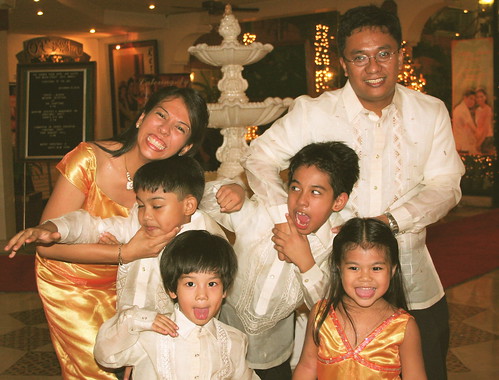
My cousin, Maria Estela Felipa "Estee" M. Aceron, was recently elected as Vice-Governor of Oriental Mindoro. Estee, armed with a law degree, a beautiful voice, and ramp model looks, has changed Mindoro politics forever.


Estee shares her winning formula in her blog. She writes.
Now, I truly say that “guns, goons and gold” are not indispensable during elections. One can still win without them. In my case, “sound system, mic and minus-one” are indispensable!

After her election, her father, Edgardo C. Aceron, hands down one of the best trial lawyers I've seen, wrote her this letter, which Estee also shares in her blog. I'd like to share it to this blog's readers to inspire more advocates for the politics of "sound system, mic and minus-one."


Sta. Maria Village
Calapan City , Oriental Mindoro

17 May 2007

Dear Estee,

Three days after elections, we already know that your victory in the vice-gubernatorial race is almost a certainty. In the latest PPCRV Partial Results of the Official Canvass, you are leading by a wide margin of more than 74,000 votes over Dr. Tony delos Reyes. And your votes are still pouring in. By all indications, you are winning overwhelmingly in Calapan City as well as in all Municipalities in Oriental Mindoro except only in Pinamalayan, the home town of your political adversary.

Since the time that you decided to cast your lot in the political arena (in the 2001 elections when you ran and won as 1st councilor of the city, through the 2004 elections when you were elected as number 1 board member, until today, when victory in the recently concluded elections is already at hand), your rise in the political horizon is meteoric. However, as a concerned parent, amidst the euphoria of success, I have my own fears and apprehension about your private life, your career and most especially, your future in politics.

You see, you have a lucrative law practice in Metro Manila You are still single at the age of 33 years and from what I observed I am suspecting that you are beginning to like politics.

I feel guilty for introducing you to politics while you were still in your fledgling years, You are aware that early in my own political life, I was involved in the struggle to change the system of politics - geared towards giving poor and deserving candidates for political positions equal footing with the rich and the affluent. Even when you were still in high school you joined me in our crusade against the politics of patronage and against candidates with guns, goons and gold. I sincerely believed then, that I could attain our noble objectives during my time. But I was wrong, I lost, miserably.

After that pitiful loss we vowed never to get involved in politics again. I remember you were the most vocal among the members of the family against any of us getting involve in politics again. But as fate would have it. This is not to be so.

It came to your mother and I as big surprise when in November 2001, while in Los Angeles , California , we received an overseas call from you informing us that you have given your word to Mayor Arnan Panaligan, that you are consenting to run as councilor of the city under his slate. That hastened my vacation as I immediately rushed back to Calapan City , Oriental Mindoro to prepare for the campaign.

Thus began your own quest for your rightful place in the political spectrum. Political observers say that by all standards, your performance in politics, from the start until now, from councilor to vice governor in so short a time, is nothing but impressive and spectacular.

We cannot really fathom the ways of the Lord. In this election we did not act like traditional politicians. More than the honor of being the vice governor of the province, your victory is most especially significant and meaningful to me because it was the fulfilling grace for me that eased the angst and agony of defeat that I have been nurturing all through the years.

We did not have the guns, goons and gold, yet we won. You have continued my crusade and proved to the world that we could do away with the politics of patronage and still win overwhelmingly over our political opponents. From father to daughter, I thank you for redeeming our name in politics.

But honestly I am afraid. My fatherly instinct obliges me to make you realize that politics is dirty - that it may be better for you to choose and pursue your career and to have a family of your own. Your future in politics is uncertain. Next election you will not be as young as you are now. By that time, Mom and I, would be older and may no longer be able to withstand the rigors, inconveniences and ordeal of campaign. Without the necessary logistics, you will be charting a very dangerous course.

Having made a clean breast of everything to you, the decision is still yours to make. To paraphrase a famous quotation from "Invictus", by British poet William Ernest Henley, "You are the master of your fate and the captain of your soul." We shall always abide and respect your decision.

As a parting word: GO AND FULFILL YOUR DESTINY

May the Good Lord and the Holy Spirit guide and keep you always!

We love you,

Dad & Mom

Tuesday, May 22, 2007

Notes on the 2007 Elections (Part One)

1. I had a big laugh over the story on how politicians in Legazpi City had long faces after they went for broke on election day. With votes being sold for as high as PHP 1,100 for a straight slate vote, some politicians spent millions just for vote-buying. I went around Legazpi City, and it was noticeable how happy the people were with their crisp peso bills stapled in denominations of PHP 600 and PHP 1,100. They packed up Gaisano mall to the roof, and I've never seen Mcdonald's with that much business before. In contrast, the candidates with their broke wallets await the canvassing results, their tempers flaring as allegations of cheating delay their proclamation. The candidates would continue to spend hundreds and thousands of pesos everyday until they get proclaimed. You would think they're crazy burning all that money.

But of course, we all know that after the election fever is gone, the winners proclaimed, and the voters have spent the last two-hundred peso bill, it would be the politicians turn to laugh. The division of spoils, as it were, would commence for contracts and projects with favored contractors and "twenty-percenters". The situation in Legazpi City is probably the same in many parts of the country, with the elections becoming an industry, and election day being the day for the voters' big pay-out. In between elections, the elected politicians fill up their bank accounts with commissions and ghost projects and save enough for the next pay out. No wonder this country is one of the most corrupt countries in the world.

2. On the Pampanga elections, I'm beginning to see the election of the Catholic priest on leave, Among Ed Panlilio, as Pampanga governor in a different light. His election to the office seems to be a rejection of the established political elite in the province whose base of power rests on illegal gambling and illegal sand quarrying. But if you look at the figures, Among Panlilio's votes is just a little higher than one third of the total votes cast, and the two other candidates are less than 10,000 votes away from his winning margin in a province with about a million votes. If the two candidates unite --they used to be allies by the way -- Among's going to have the mandate only of the minority. This means that once Among commences his fight against illegal gambling and corruption in sand-quarrying in the province, Among's army of supporters are going to be out-numbered two-to-one. In order to succeed, Among has to develop some allies among the local and national leaders. But the problem is almost everyone in the local political arena in Pampanga has been compromised by illegal gambling and corruption. Thus, Among's best bet for help is with the national leaders. But would Among be open to an alliance with the GMA gang who are likewise compromised? Would Among be open to be an ally of morally compromised leaders at all?
Such would be the dilemna of a governor who happens to be a Catholic priest on leave -- shades of Faust and Mephistopheles.

Friday, May 18, 2007

Fr. Ed Panlilio proclaimed Pampanga Governor

Fr. Ed Panlilio, Catholic priest on leave, has been proclaimed Pampanga governor.

The winning margin is a mere 1,147 votes. That's a measly PHP 1,147,000 for the vote buyers who bought votes PHP 1,000 per vote. The priest got 219,706 votes, Lilia Pineda got 218,559 votes, and re-electionist Governor Mark Lapid received 210,875 votes.

Really amazing.

All Eyes on Pampanga

I was doing some election work in Pampanga on election day. As votes were getting counted, I heard the report that the turnout was about 60% of the 1,000,000++ votes of Pampanga. But due to the very close fight, my calculation was that the winning vote count should be 210,000. As of the latest count, the candidates are racing to the 200,000 mark with Pineda leading and Panlilio a close second and Lapid a couple of tens of thousands away as third.

Based on advance information on the tabulated election returns, however, Panlilio appears to be a clear winner by a margin of about 1,000 votes over Lilia Pineda. Panlilio took votes from San Fernando and Bacolor, while Pineda brought in a lot from Lubao. Lapid hauled votes from Arayat. However, the Statement of Votes for Mabalacat are being questioned by the Pineda lawyers. Mabalacat has about 60,000 voters, and thus it could swing the votes for any of the three candidates.

Thus, the three-cornered fight might be decided only by just one town, Mabalacat.

On a personal note, I am impressed by Fr. Panlilio's rise as a political player with only 45 days of campaigning. He has put up a good fight, and the people of Pampanga have made a clear statement against the ruling political elite. Let's hope the electoral process resolves itself well in this province.

Thursday, May 10, 2007

Mayor Alex Aranas of Pola, Oriental Mindoro on ABS-CBN


Mayor Alex Aranas on ABS-CBN. He relates the details of his abduction by the NPA last Friday, May 4, 2007. The NPAs told him to leave Pola immediately and not to return until after election day. If this is not lawlessness, I don't know what is.

UPDATE: NPAs admit abducting Mayor Alex Aranas. See Abs-cbn news here.

Wednesday, May 09, 2007

Filipino with the "F": A Guide for the Perplexed (Part One)

During the proceedings of the 1986 Constitutional Commission, Constitutional Commissioner Tingson stood in prayer as follows:

MR. TINGSON… Panginoon, bigyan mo po kami ng mga Filipinos nga may kasing-kasing na mahinulsulun. Nga nagahigugma sang katarungan apan nagasabdung sang kalainan. Kay, Ginoo, ito pong mga Filipinos ang aming bayan ngayon may kailangan kay amo ining mga Filipinos nga may matuod nga sadsara. (4 CONCOM 486)


The argument was that the above prayer is the new Filipino language, rich, democratic, and hardly intelligible.

That's why you don't know how thrilled I am that somebody has actually filed a case directly attacking the language policy of the government, particularly on the medium of instruction. This is not the first time somebody had done so, there were previous efforts but none were given enough attention by the Supreme Court. My thrill is not because I am an advocate of one language line -- my views have shifted from one line to another, and now I don't know where I am. More than anything, I am excited because finally the Supreme Court can have a chance to settle the issue on what is the national language.

The recent case makes a point about Filipino, and the backseat it has taken with the EO 210 and DepEd Order 36 making English the medium of instruction in schools for certain subjects. But the case that needs to be settled is about Filipino itself. Does it actually exist? What is it composed of? How can we tell if what were using is Filipino with ""F" or Pilipino with "P" or Tagalog with the "T".

I have spent my junior year in law school researching the history of our language laws, and, with my efforts and a lot of luck, this article was born: Filipino with the "F": A Construction of the National Language Policy The article was publised in the Ateneo Law Journal in 1994.

When the case goes to the Solicitor General for Comment, one of the key arguments would be the ambiguity of Filipino with "F", and the difficulty in obtaining learning materials in a language not yet developed. And with that the Supreme Court will have no choice but to settle the question, what is the Filipino language?

In the meantime, I'm blogging the article here in series.


FILIPINO WITH THE “F”:
A CONSTRUCTION OF THE NATIONAL
LANGUAGE POLICY

by ELDRIGE MARVIN B. ACERON*


INTRODUCTION

The absence of a settled definition of Filipino has triggered many long and winding debates on the nature and character of the Philippine national language. The esteemed author Edilberto Alegre, for instance, writes that the distinction between Filipino and Pilipino exists only in the statutes. As written and spoken, Filipino and Pilipino are similar, and to maintain the distinction is to be foolish. But as others hold, the distinction is substantive.2 Pilipino, is a mere component of Filipino, since the former is based solely on Tagalog while the latter is based on all existing Philippine languages. Undoubtedly, the State’s legal intervention in the national language issue has done much to confound the problem. The different shifts in the language policy have brought enough confusion not only to the people but also to policy-makers themselves. Hence, to untangle the complications which have developed on the subject throughout its legal history, an historical and legal construction is in order.

I. THE LEGAL PROBLEM

A. Definitions

“Pilipino,” on one hand, is the national language declared3 by then President Manuel Quezon by authority of Commonwealth Act 184.4 It is based on Tagalog, an existing language which is native to the inhabitants of the provinces of Bulacan, Rizal, Batangas, Laguna, Cavite, and Quezon among others. “Filipino,” on the other hand, is the national language consisting of a fusion of all languages in the country the number of which range from forty (40) to ninety (90) depending on how one distinguishes a language from a dialect.5

It is admitted, however, that there is no established language which consists of a fusion of all languages in the Philippines. If ever one does exist, the most that can be said about it is, that it is underdeveloped. In this view, a noted linguist declared, Filipino is a mere “linguistic legal fiction.”6 In Tumang v. Bautista, et. al.,7 a case for damages, the plaintiff filed his complaint in Filipino. The defendant objected on the ground that the complaint did not use the official language, i.e., it was not in English. The trial court admitted the complaint, but on review, was reversed by the Supreme Court. Speaking for the Supreme Court, Justice Vicente Abad Santos held that Filipino is still a gestating language as the National Assembly failed to take appropriate measures to develop Filipino as mandated by the 1973 Constitution.8 Thus, from this ruling, it is clear that litigants may validly object to pleadings written in Filipino. Moreover, judges should avoid writing decisions in that language.

Curiously, under Executive Order No. 335,9 Filipino was made an official10 language by mandate of the 1987 Constitution. In this regard, the Department of Education, Culture, and Sports issued an order11 prescribing guidelines for the use of Filipino as a medium of instruction. If Filipino is a gestating language or a linguistic legal fiction, how can it be used as an official language or a medium of instruction? Needless to state, only an established language or a medium of used as a language of official communication or medium of school instruction. In other words, Filipino is an ambiguous concept. This ambiguity is the foremost hindrance to the effective implementation of the national language policy. Hence, the meaning of Filipino must be defined and articulated to overcome this hindrance.

B. Approaches

There are two (2) ways to understand the concept of Filipino: the Complete Amalgamation Approach and the Universal Approach. The former is attributed to Dr. Demetrio Quirino, Jr.12 and proposes that all languages in the Philippines must have a democratic representation in Filipino. Philippine languages will have an allocated percentage in the phonology, morphology, syntax, and vocabulary of Filipino according to the population of the speakers. Tagalog will only have an allocation of thirty (30%) per centum. This approach was explicitly rejected by the 1986 Constitutional Commission.13

The second perspective is the Universal Approach14 developed by Dr. Ernesto Constantino. Under this, Filipino is based on the national lingua franca, or the language used by persons with different linguistic backgrounds. The lingua franca is said to have evolved informally. This approach does not subscribe to the democratic allocation proposed by the Complete Amalgamation Approach. Instead, it allows a single language to be the nucleus of Filipino. The nuclear language is then developed by allowing other languages to influence it through usage and standardization. Filipino, under this approach, is said to be similar to the taglish15 variety of Pilipino spoken in Metro Manila.

Dr. Ponciano Pineda, the Director of the Surian ng Wikang Pambansa (SWP), provides a schema16 to further understand the universal approach. According to him, the manner of developing the multi-language based Filipino is by using Pilipino as the nucleus or the corpus of the language, and by allowing the corpus to assimilate popular words and phrases from other Philippine and foreign languages through a process of rigorous selection. Naturally, there will be modifications in the lexicon, grammar, and orthography of the corpus. These changes will then be assimilated through standardization. Then, the government must expand the usage domain of the corpus to include the fields of education, culture, public administration, sciences, technology, lawmaking, judiciary, society, and media to develop the language. In the meantime, Pilipino, the corpus, is similar to Filipino. But after a period of development, the multi-language based Filipino may then be realized.

This study uses this second approach in arriving at a definition of Filipino. It is, however, necessary to indulge in a digression on the origin and history of Filipino in order to fully appreciate its meaning and context.

II. HISTORY OF THE MONO-LANGUAGE AND MULTI-LANGUAGE BASED NATIONAL LANGUAGE

A. Deception in the 1934 Constitutional Convention

The need for a single unifying language in the Philippine archipelago had been the constant concern of the Spanish and American colonizers and even the Philippine Revolutionaries. There were attempts to impose an official language through legislation, but none would leave a lasting effect other than the drafting and subsequent ratification of the 1935 Constitution. This ushered in the rivalry between those who advocated a national language based on one language (the mono-language based movement) and those who advocated a national language based on all existing native languages (multi-language based movement). An overwhelming sentiment17 to adopt a local language as a national language which would eventually replace English moved the delegates of the 1934 Constitutional Convention (1934 CONCON) to consider the proposition18 of Delegate Villanueva making Tagalog the national language. The Villanueva proposition started the mono-language based national language movement (hereinafter the mono-lingualists), as it would later be known. Delegate Villanueva said that it was time for the Filipinos to set aside their sectionalism for the purpose of achieving a common goal – the selection of a common language.19 Among the dialects in the Philippines, Tagalog had the surest promise of developing into a national language, because it was widely spoken.20 It was the language of the capital.21 It also had a formidable body of literature.22

In opposition to the Villanueva proposal, Delegate Bueno stated that it was more prudent not to mention any native dialect in the Constitution and to leave to time the selection of a national language.23 Mentioning a native dialect in the Constitution would foster impressions of preference, thus breeding division instead of cohesion.24 Moreover, there were other dialects, aside from Tagalog, that could just as well serve as the national language.25

In the course of the debate, Delegate Briones objected to the Villanueva proposition. He suggested that the dialects of the Visayan Islands and Mindanao and another of those of Luzon, be unified, primarily through their literature. From the two unified systems would later evolve a national language.26 This unification would not be difficult to attain, in view of the common Malay origin of the Philippine dialects.27 Delegate Briones’ suggestion marked the conception of a multi-language based national language. Eventuallym the Villanueva proposition was defeated, 71 votes against 47.

Without further debate, the delegates approved a compromise provision on the national language submitted by Delegate Vinsons. It stated:

The National Assembly shall take steps towards the development and adoption of a common national language based on existing native dialects.

Until otherwise provided by law, English and Spanish shall be the official languages.28

It appeared that the multi-language based national language bloc scored a victory with the approval of the Vinsons provision.29 The victory, however, was short-lived. When the Style Committee considered the provision, it amended the provision so that the national language was to be based on one of the existing native languages instead of all of them. Note that the amendment was more than a matter of style; it affected the substance of the provision. This action raised questions on the propriety and validity of the provision. It was, however, voted and carried on readily by the Convention. The provision read:

The National Assembly shall take steps toward the development and adoption of a common national language based on one of the existing native languages. Until otherwise provided by law, English and Spanish shall continue as official languages.30 (emphasis supplied)

The entire draft of the Constitution with the altered languages provision was then approved by the 1934 CONCON on 8 March 1935. U.S. President Roosevelt signed it on 23 March 1935. It was ratified in a plebiscite on 14 May 1935. It may be said, therefore, that the irregularity was cured.

Charges were hurled against the President of the 1934 CONCON, Claro M. Recto, and the members of the Style Committee for submitting to the alleged prodding of Senate President Manuel L. Quezon to rephrase the Vinsons provision.31 The charges were never proved, but such did not endear President Quezon32 to the non-Tagalogs and the multi-language based national language movement (hereinafter the multi-lingualists). In the meantime, the multi-lingualists quietly acquiesced to the turn of events.

Footnotes
____________________

* Juris Doctor 1995, Notes and Comments Editor, Ateneo Law Journal, 1993-1994, Associate Editor, 1994-1995
Edilberto Alegre, Filipino is the National Language in Monico M. Atienza, Kilusang Pambansa Demokratiko sa Wika 300 (1992).
2 In 1969, two civil actions were filed against the Surian ng Wikang Pambansa (SWP) questioning SWP’s authority to propagate Tagalog as the basis of Pilipino. These cases were: Ferrer v. CA, et. al. CFI of Manila Branch VII, Civil Case No. 53048, 10 October 1969, docketed as L-32167 in the Supreme Court and dismissed on a minute resolution in 1970; and Madyaas Pro-Hiligaynon Society v. Surian ng Wikang Pambansa, CFI of Manila, Civil Case No. 77548, 28 January 1971.
3 Executive Order No. 134 (1937).
4 13 November 1936.
5 Emy M. Pascasio, The Language Situation in the Philippines from the Spanish Era to the Present, Brown Heritage, (A. Manuud ed. 1969).
6 Quoting Bro. Andrew Gonzalez, FSC, Ma. Teresa R. Robles, A Filipino Language at Last, in Development Issues: Constitutional Response 25 (Florangel Rosario-Braid ed. 1987).
7 136 SCRA 682, at 685 (1985)
8 Id. It appears that Justice Abad Santos ignored the difference between Pilipino and Filipino. Nevertheless, it is clear that he is referring to Filipino alone.
9 1988.
10 An official language must be differentiated from a national language. The official language is the prescribed means of communications in government transactions. A national language is the language used generally in the country. The government has the right to insist that official communications be done in the official language which may not necessarily be the national language.
11 Department Order No. 81 (1987).
12 Pociano Pineda, Ang Wikang Pambansa sa Saligang Batas, Limampung Taon ng Surian ng Wikang Pambansa: Huling Isa’t Kalahating Dekada (1970-1987) 61 (Aurora E. Batnag ed. 1987).
13 Commissioner Ople’s interpellaton with Commissioner Bennagen on the 1 September 1986 session proves this assertion.

MR. OPLE Does the committee, however, believe, that the enrichment, expansion and indefinite strengthening of the living language through assimilation will have to be done in the course of the evolution of this language, and that it is not the intention of the committee to prescribe certain quotas, according to quotas of assimilation from different languages, in accordance with a certain fiat of the government?

MR. BENNAGEN. No Madam President, because we look at the language as an organic thing which has its own logic of growth; therefore, we must follow that x x x

See 4 Records of the Constitutional Commission 153 (hereinafter Concom).
14 Ernesto Constantino, Ang “Universal Approach” at ang Wikang Pambansa ng Pilipinas, Filipino o Pilipino? Mga Bagong Babasahin sa Pambansang Wika at Literatura (Ernesto Constantino, et al. eds. 1974)
15 This variety of Pilipino employs a loose mixture of Tagalog and English.
16 See Pineda, supra note 13 at 32.
17 Jose Aruego, The Framing of the Philippine Constitution, 639-640 (1949 reprint).
18 Actually, the proposition was in the form of an amendment to the proposed draft of the Committee on Official Languages. The draft stated: A national language being necessary to strengthen the solidarity of the Nation, the National Assembly shall take steps looking to the development and adoption of a language common to all the people on the basis of the existing languages. (Id., at 636).
19 Id. at 642.
20 Id.
21 Id.
22 Id.
23 Id.
24 Id. at 643.
25 Id.
26 Id. at 644.
27 Id.
28 Id.
29 Historians refer to this as the Vinsons Amendment.
30 Id. at 645.
31 Leopoldo L. Yabes, History of Filipino as the Common National Language, Language Planning and the Building of a National Language (Bonifacio P. Sibayan and Andrew Gonzalez, FSC eds. 1977.)
32 Prof. Yabes attributes this alleged act of Pres. Quezon as the basis for Pres. Quezon’s designation as the Father of the Pilipino Language, and the celebration of the National Language Week in the week of his birthday August 19. The designation is not officially conferred. The celebration of the language week during Pres. Quezon’s birthday was based on Proclamation No. 7 (1955). Id. at 645.

Saturday, May 05, 2007

Declare Martial Law on Pola Now!

I was shocked to hear the news last night that my uncle, Mayor Alex Aranas, was abducted by NPA guerrillas after engaging them in brief gunfight in a faraway barangay of Matula-tula in our hometown Pola, Or. Mindoro. Today, the news is that as a condition for his release, Mayor Alex Aranas has been ordered by the NPAs who abducted him to leave the town. Mayor Alex appears to have resolved to leave, in spite of his re-election campaign, for his safety and his family.

I don't know what the Commander-in-Chief is thinking about this situation, if she is thinking about it at all, but I hope she realizes this shows that the NPA's have effective control over my town. By showing their ability to abduct an incumbent mayor -- not once but twice! -- they have also shown that their power over the town is uncontested. The NPAs could take anybody they want, tell anyone what to do, and turn the town into a showcase of communist rule.

The last time I was in my hometown was in November 1, 2001 when NPA amazons raided the Pola police armory and sped away with all government issued guns on board a rented van. My family was so terrified, I haven't gone back since then. In 2004, the same group of NPA guerrillas abducted Mayor Alex Aranas for his failure to pay permit to campaign fees. He was only released after promising to pay (I don't exactly know if he did).

I was planning to spend election day next week in the beaches of Pola with my kids, but with this disturbing news that not even my uncle, who is the mayor of the town, is going to be safe there, I guess I have to put off the plan.

Pola is the hometown of the Vice-President, Noli de Castro, who happens to be a good friend of my uncle, and the President herself has been to our town twice, the only President to have ever visited our town. It is also the only town in Or. Mindoro where she won fair and square in the 2004 elections. But with this town turning into an NPA haven, civilian authority no longer matters there.

The Vice-President's town should never become an NPA haven. The President should take decisive action and restore the rule of law in our town. Declare martial law in Pola now.

Sunday, April 15, 2007

Business is the Captain of Corruption

This is a reply to MLQIII's post on the rising belief that business is going to save this country. I say this is 100% dog shit. Business is the captain of corruption in this country. I look at the big leaders of today's business, and I see not a single bone of integrity and not a single drop of blood not motivated by an appetite.

Look at this multi-billion earning companies, how did they acquire that dominance in the market? -- by paying off every public official who gets in the way or by giving fees to public officials who squeeze private resistance to their companies' build-up. Save for a few exceptions, I can say this straight on the face of every big businessman in this country, especially those who fancy themselves as saviors.

How can business help save this country? A big player who corrupts creates a trickle down effect on the entire bureacracy. It sends the signal that the only way for bureaucrats to attain material success is to become the padrino of a big company --i.e. If you become President, a big businessman will pay PHP20,000,000 if you help out in their hostile take over bid of one of your country's corporate crown jewels. It starts a pricing war among the business players. Whoever pays the highest gets what he wants. In the meantime, the law, integrity, and public welfare are set aside in favor of the highest bidder.

When I was trying to negotiate a distribution deal in Vietnam, one of the principals with me blurted to the other side, "I like your country, because it's as corrupt as ours." I don't know how that kind of statement can win a negotation, but it reflects the thinking of business. It's better to bribe than to follow the rules. It makes costs manageable and risks predictable.

Since business holds the wealth in this country, the only way for them to save this country is for them to stop bribing public officials, get a bone of integrity implanted on their slimy backs, and get a blood transfusion from the monks of Tibet. After all, if they won't pay up and no one else pays up, what would be left for the greedy bureaucrat to do, but do his job or resign.

Sunday, April 01, 2007

Wifey Chronicles No. 1

Me: I'm not arguing with you.
Ces: Then, just say yes with what I have to say.
Me: What? You know the problem with this marriage is there is no democracy.
Ces: Look, we'll have a bigger problem if we put democracy in this marriage.
Me: And why is that?
Ces: Because there is no one here to break the tie.
Me: oh...

Wednesday, March 28, 2007

Notes on the Anti-Terrorism Law (Part 5)

IX. We come now to the second authorized legal intrusion into private rights under the Anti-Terrorism Law, the detention of suspected terrorists.

The Anti-Terrorism Law authorizes the warrantless arrest of a person charged with or suspected of the crime of terrorism or the crime of conspiracy to commit terrorism under the following circumstances:

1. There is an authority in writing from the Anti-Terrorism Council
2. The subject of the arrest is a person charged with or suspected of the crime of terrorism or the crime of conspiracy to commit terrorism
3. The arrest results from the surveillance authorized under Section 7 (discussed in an earlier post) and examination of bank deposits under Section 27 (to be discussed later)


Section 18 of the law gives the law enforcement personnel who arrested the suspected terrorist a period of three (3) days counted from the moment of arrest to submit the arrested terrorist to the proper judicial authority.

The general rule on warrantless arrests of person is provided in Section 5 Rule 113 of the Revised rules of Criminal Prcedure, which states as follows:

Sec. 5. Arrest without warrant; when lawful. – A peace officer or a private person may, without a warrant, arrest a person:

(a) When, in his presence, the person to be arrested has committed, is actually committing, or is attempting to commit an offense;

(b) When an offense has just been committed and he has probable cause to believe based on personal knowledge of facts or circumstances that the person to be arrested has committed it; and

(c) When the person to be arrested is a prisoner who has escaped from a penal establishment or place where he is serving final judgment or is temporarily confined while his case is pending, or has escaped while being transferred from one confinement to another.


Obviously, the provision under the Anti-Terrorism Law for the warrantless arrest a suspected terrorist appears to be a new exception to the rule on warrantless arrests under the Rules on Criminal Procedure. The problem here is that with this provision, Congress appears to be legislating on the matter of criminal procedure in the protection and enforcement of a constitutional right. Under Section 5 Article VIII of the Constitution, the Supreme Court has the jurisdiction to "promulgate rules concerning the protection and enforcement of constitutional rights" Thus, the issue is, Congress may have legislated on a matter which is the exclusive province of the Supreme Court.

Fr. Joaquin Bernas, S.J., in his commentaries on the Constitution, says the power of Congress to legislate on rules of procedure was recognized by the Constitutional Commission, but after the debates on the issue and as a matter of compromise, the Constitutional Commission did not make this power explicit in the text of the 1987 Constitution. This opinion, however, has not yet been supported by jurisprudence.

Thus, this provision of the Anti-Terrorism Law on the warrantless arrest of a suspected terrorist may be challenged as an unwelcome encroachment on the powers of the Supreme Court under Article VIII Section 5 of the 1987 Constitution.

Wednesday, March 14, 2007

NOTES ON THE NEW ANTI-TERRORISM LAW (Part 4)

VIII. We come now to a discussion on one of the novel legal intrusions on the rights to privacy that has been sanctioned by the Anti-Terrorism Law.

Section 7 of the Anti-Terrorism Law provides for the requisites under which surveillance of private communications shall be allowed, as follows:

1. It must be done by a police or law enforcement official and the members of his team.

2. There must be a written order of the Court of Appeals

3. The authority given by the Court of Appeals shall be listen to, intercept and record, with the use of any mode, form, kind or type of electronic or other surveillance equipment or intercepting and tracking devices, or with the use of any other suitable ways and means for that purpose,

4. The object of the surveillance shall be any communication, message, conversation, discussion, or spoken or written words

5. The subject shall be communications between members of a judicially declared and outlawed terrorist organization, association, or group of persons or of any person charged with or suspected of the crime of terrorism or conspiracy to commit terrorism.

The law, however, provides exceptions with respect to the surveillance, interception and recording of communications between the following:

1, lawyers and clients,
2. doctors and patients, and
3. journalists and their sources and confidential business correspondence.

This is one of the controversial provisions of the law, because it excludes surveillance of private communications covered by this law from the application of the Anti-wire Tapping Law or Republic Act No. 4200. The issue is will this provision violate the Constitution, particularly, Art. III section 3? It states as follows:

Section 3. (1) The privacy of communication and correspondence shall be inviolable except upon lawful order of the court, or when public safety or order requires otherwise, as prescribed by law.

(2) Any evidence obtained in violation of this or the preceding section shall be inadmissible for any purpose in any proceeding.


The requirement of an order from the Court of Appeals stated in the Anti-Terrorism Law appears to fit the exception provided by the Constitution on the inviolability of the privacy of communication and corresppondence. Thus, the argument that this provision is unconstitutional appears to be very weak.

Further, in securing this order from the Court of Appeals, the law provides a rigorous procedure in Section 8. The provision states that the authority shall be granted by the authorizing division of the Court of Appeals only upon compliance with the following requirements:

1. An ex parte written application of a police or of a law enforcement official who has been duly authorized in writing by the Anti-Terrorism Council created in Section 53 of this Act to file such ex parte application,
2. Upon examination under oath or affirmation of the applicant and the witnesses he may produce to establish:

(a) that there is probable cause to believe based on personal knowledge of facts or circumstances that the said crime of terrorism or conspiracy to commit terrorism has been committed, or is being committed, or is about to be committed;
(b) that there is probable cause to believe based on personal knowledge of facts or circumstances that evidence, which is essential to the conviction of any charged or suspected person for, or to the solution or prevention of, any such crimes, will be obtained; and,
(c) that there is no other effective means readily available for acquiring such evidence.


The procedure appears to mirror the provisions of Section2 Article III of the Constitution with respect to the issuance of search and arrest warrants, except that the Anti-Terrorism Law required a higher court, the Court of Appeals, as the court from where the authority for surveillance may be secured. Section 2 Article III of the Constitution states:

Section 2. The right of the people to be secure in their persons, houses, papers, and effects against unreasonable searches and seizures of whatever nature and for any purpose shall be inviolable, and no search warrant or warrant of arrest shall issue except upon probable cause to be determined personally by the judge after examination under oath or affirmation of the complainant and the witnesses he may produce, and particularly describing the place to be searched and the persons or things to be seized.


By wording this provision in a simlar manner, Congress incorporates by analogy to the Anti-Terrorism Law the wealth of jurisprudence that has evolved in the Philippines relating to the procedure of the examination of the applicant and his witnesses and the finding of probable cause.

Thus, this novel legal intrusion sanctioned by the Anti-Terrorism may survive the anticipated constitutional challenge from the human rights activists.

Monday, March 12, 2007

Notes on the New Anti-Terrorism Law (Part 3)

VII. Section 17 provides the Department of Justice with the remedy of having an organization, association, or group of persons declared as a terrorist group upon application, with notice and opportunity to be heard, with the Regional Trial Court. The declaration of an organization as an outlawed terrorist group triggers for the government its rights to exercise the powers of surveillance of private communications (Sections 7 to 16) and examination of bank accounts under section 27 to section 43) The law, however, requires that an organization may only be declared as an outlawed terrorist group upon notice and opportunity to be heard. To be declared as a terorrist organization, the DOj has to prove that the organization actually uses the acts to terrorize mentioned in the law to sow and create a condition of widespread and extraordinary fear and panic among the populace in order to coerce the government to give in to an unlawful demand. Section 17 states,


SEC. 17. Proscription of Terrorist Organizations, Association, or Group of Persons. – Any organization, association, or group of persons organized for the purpose of engaging in terrorism, or which, although not organized for that purpose, actually uses the acts to terrorize mentioned in this Act or to sow and create a condition of widespread and extraordinary fear and panic among the populace in order to coerce the government to give in to an unlawful demand shall, upon application of the Department of Justice before a competent Regional Trial Court, with due notice and opportunity to be heard given to the organization, association, or group of persons concerned, be declared as a terrorist and outlawed organization, association, or group of persons by the said Regional Trial Court.


My first impression was that this might be a superfluous procedure, because if the DOJ has evidence that an organization is a terrorist organization, it might as well sue the members for committing the crime of Conspiracy to Commit Terrorism. Yet, upon closer examination, it appears to be a way to shortcut the process of convicting actual terrorists. Once an organization is declared a terrorist, then all members will be deemed guilty of the crime of Conspiracy to Commit Terrorism, and all the police has to do is prove people's membership in the terrorist organization.

The question is how will a judge distinguish among members, affiliates, supporters, sympathizers, friends, relatives, and neighbors of the terrorist organization, or among the supporters, sympathizers, friends, relatives, neighbors of the members of the terrorist organization, or friends of the supporters of the members of the terrorist organization? It seems to me the DOJ will all have them bunched as one group of terrorists to be sued and jailed. It is a potential tool for witch-hunting. There is a danger for people to be declared as terrorists by association regardless of the degree of association. This is so because in a conspiracy the doctrine is "the act of one is the act of all." Thus, for so long as a person's association with a judicially declared terrorist organization is proven, he will be guilty of Conspiracy to Commit Terrorism and punished as such. If the National Democratic Front, for example, is declared as a terrorist organization, even Joma Sison's dance instructor could be jailed for Conspiracy to Commit Terrorism.

(To be continued)

Saturday, March 10, 2007

Notes on the New Anti-Terrorism Law (Part 2)

IV. The Anti-Terrorism Law does not appear to provide a penalty for frustrated or attempted stage of the crime of terrorism. Does this mean that the crime is only punishable in the consummated stage? My reading, however, is the crime of Terrorism is punished regardless of the stage of commission. When the law states that, "Any person who commits an act punishable under any of the following provisions of the Revised Penal Code: x x x or under (the Special Penal laws enumerated therein)" , it includes all stages of commission of the crimes enumerated. Thus, for so long as the other elements of Terrorism concur, the crime is punished as consummated with 40 years imprisonment.

The scenario is, for example, the case when a murder is frustrated because the victim survives the attack. Assuming the other elements of Terrorism concur, can we say that the crime is frustrated Terrorism? No, because the frustrated murder already meets the first requisite for the crime of Terrorism. Thus, regardless of the stage of commission, for so long as all the elements of the crime are present, Terrorism is committed and punished with 40 years in jail.

V. The Anti-Terrorism Law fixes the penalty for the crime of Terrorism at 40 years, without the benefit of the Indeterminate Sentence Law. In general, the Indeterminate Sentence Law tends to lower the penalty for the crime depending on the attendant circumstances to the crime. With respect to the crime of Conspiracy to Commit the Crime of Terrorism, which is penalized also with with 40 years of imprisonment, the Anti-Terrorism Law did not exempt it from the application of the Indeterminate Sentence Law. Conspiracy to Commit terrorism is committed when two or more persons come to an agreement concerning the commission of the crime of terrorism and decide to commit the same.

VI. Accomplices and accessories to the crimes of Terrorism and Conspiracy to Commit Terrorism are punished by a penalty of seventeen (17) years, four (4) months one day to twenty (20) years of imprisonment and ten (10) years and one day to twelve (12) years of imprisonment respectively. Note that for accomplices and accessories, the penalty provided is a range. What would be the standards that a judge can use in graduating the penalty for Terrorism? Will the mitigating and aggravating circumstances provided by the Revised Penal Code be applicable? There appears to be no references to mitigating and aggravating circumstances so my opinion is these may not be applicable.

(To be continued)

Thursday, March 08, 2007

Notes on the new Anti-Terrorism Law

On March 6, 2007, Pres. Gloria Macapagal Arroyo signed the landmark legislation on terrorism, known as REPUBLIC ACT NO. 9372, AN ACT TO SECURE THE STATE AND PROTECT OUR PEOPLE FROM TERRORISM (hereinafter, "RA 9372" or the "Anti-Terrorism Law"). Media reports have it that various civic groups are preparing to challenge its constitutionality before the Supreme Court even as businessmen and international allies of the Philippines hail its passage. Indeed, RA 9372 appears to be a controversial piece of legislation as the law attempts to empower state agents by allowing legal intrusions into private communications, bank accounts, and personal liberties in order to curb the growing menace of terrorism. Thus, the challenge to the Supreme Court is to determine whether these legal intrusions are sanctioned by the 1987 Constitution.

While the national security agents and the human rights activists prepare for the case to be filed before the Supreme Court, we will attempt to comprehend this law and see how it will affect our lives. What follows is my notes and analysis based on my own reading of the law.


I.
The Anti-Terrorism Law is composed of 62 sections, which could be divided into five divisions:

A. Terrorism, definition and principles

1. Declaration of Policy (Sec. 2)
2. Definition of Terrorism (Sec. 3)
3. Definition of Persons Liable (Sec. 4,5 and 6)
4. Proscription of Terrorist Organizations, etc. (Sec 17)

B. Legal Intrusions to Private Rights

1. Surveillance of Private Communications (Sec. 7 to 16)
2. Detention of terrorists (Sec. 18 to 25 and Sec. 44)
3. Restrictions to Travel (Sec. 26)
4. Examination of bank accounts, etc. (Sec. 27 to 43)

C. Special Rules and Principles

1. Immunity of government witnesses (Sec. 45)
2. Illegal use of Classified Material (sec. 46)
3. Remedial procedures and principles applicable to terrorism (Sec. 47- 52)
4. Special provisions on extraordinary rendition (Sec. 57) and extra-territoriality Sec. 58),

D. Administrative Bodies on Terrorism

1. The Anti-terrorism council and the role of other government agencies (Sec. 53-56 and Sec. 59)

E. Effectivity provisions

1. Effectivity clauses (Sec. 60-62)


As can be seen from the scope of the law, it appears to be comprehensive. It's almost like a codification of the powers of the state against terrorism and the rights of individuals against the abuse in the use of these powers. In addition, the law also provided for detailed procedures on how the state may exercise these powers, i.e., the legal intrusions to private rights, including penalties for failure to comply with them.


II.
The law declares its underlying principles in Section 2 as follows:

SEC. 2. Declaration of Policy. – It is declared a policy of the State to protect life, liberty, and property from acts of terrorism, to condemn terrorism as inimical and dangerous to the national security of the country and to the welfare of the people, and to make terrorism a crime against the Filipino people, against humanity, and against the law of nations.

In the implementation of the policy stated above, the State shall uphold the basic rights and fundamental liberties of the people as enshrined in the constitution.

The State recognizes that the fight against terrorism requires a comprehensive approach, comprising political, economic, diplomatic, military, and legal means duly taking into account the root causes of terrorism without acknowledging these as justifications for terrorist and/or criminal activities. Such measures shall include conflict management and post-conflict peace-building, addressing the roots of conflict by building state capacity and promoting equitable economic development.

Nothing in this Act shall be interpreted as a curtailment, restriction or diminution of constitutionally recognized powers of the executive branch of the government. It is to be understood, however, that the exercise of the constitutionally recognized powers of the executive department of the government shall not prejudice respect for human rights which shall be absolute and protected at all times.


From the wording of the above declaration of principles, already one can tell the tension between the state policy against terrorism and the policy to uphold civil liberties. As one reads the rest of the law, it is easy to notice that for every power granted to the state to curb terrorism under this law, the law also provides for a means to temper this power. It is a duality that pervades the entire law, and one wonders whether the decision to craft the law in this manner will actually achieve anything for the survival of the state. Nonetheless, the message appears to be very clear that the law cannot be abused to serve the ends of those in control of the government to stop their enemies in the guise of stopping terrorism.


III.
The law then defines terrorism in Section 3 as follows:

SEC. 3. Terrorism. – Any person who commits an act punishable under any of the following provisions of the Revised Penal Code:

1. Article 122 (Piracy in General and Mutiny in the High Seas or in the Philippine Waters);
2. Article 134 (Rebellion or Insurrection);
3. Article 134-a (Coup d‘Etat), including acts committed by private persons;
4. Article 248 (Murder);
5. Article 267 (Kidnapping and Serious Illegal Detention);
6. Article 324 (Crimes Involving Destruction,

or under

1. Presidential Decree No. 1613 (The Law on Arson);
2. Republic Act No. 6969 (Toxic Substances and Hazardous and Nuclear Waste Control Act of 1990);
3. Republic Act No. 5207, (Atomic Energy Regulatory and Liability Act of 1968);
4. Republic Act No. 6235 (Anti-Hijacking Law);
5. Presidential Decree No. 532 (Anti-piracy and Anti-highway Robbery Law of 1974); and,
6. Presidential Decree No. 1866, as amended (Decree Codifying the Laws on Illegal and Unlawful Possession, Manufacture, Dealing in, Acquisition or Disposition of Firearms, Ammunitions or Explosives)

thereby sowing and creating a condition of widespread and extraordinary fear and panic among the populace, in order to coerce the government to give in to an unlawful demand shall be guilty of the crime of terrorism and shall suffer the penalty of forty (40) years of imprisonment, without the benefit of parole as provided for under Act No. 4103, otherwise known as the Indeterminate Sentence Law, as amended.


The definition can be broken down into the following elements:

1. Violation of any penal law enumerated above
2. Sowing and creating a condition of widespread and extraordinary fear and panic among the populace
3. For the purpose of coercing the government to give in to an unlawful demand.


The first element tells us that Terrorism is not exactly a new crime. To be liable under it, the criminal should at least commit one of the following: Piracy in General and Mutiny in the High Seas or in the Philippine Waters), Rebellion or Insurrection, Coup d‘Etat, Murder, Kidnapping and Serious Illegal Detention, Crimes Involving Destruction, Arson, Violation of Toxic Substances and Hazardous and Nuclear Waste Control Act of 1990, Violation of Atomic Energy Regulatory and Liability Act of 1968, Hijacking, Piracy and Highway Robbery, and Illegal and Unlawful Possession, Manufacture, Dealing in, Acquisition or Disposition of Firearms, Ammunitions or Explosives.

Absent from the above enumeration is the crime of rape. So a group of terrorists who resolve to rape women in an entire village will not be liable under this law but only for the crime of rape.

The second element in the definition, "sowing and creating a condition of widespread and extraordinary fear and panic among the populace" appears to be the heart of the definition of terrorism. Thus, without sowing and creating a condition of widespread and extraordinary ear and panic among the populace, the crime is not consummated. Yet, the words "widespread and extraordinary" fear and panic are suspect. Exactly how widespread and how extraordinary has the fear and panic should be for the crime to be considered as terrorism? If for example the target of the terrorism is just a barangay in a remote town in Mindoro where there are barely a hundred people living, would that be considered widespread? Further, extra-ordinary fear means the kind of fear that is not normally created by an attack. Yet isn't fear itself extraordinary? So I cannot imagine a situation where extra-ordinary fear is created. Atty. Romeo Capulong will have a grand time burrowing holes on this part of the definition of terrorism.

The third element -- "For the purpose of coercing the government to give in to an unlawful demand" -- is also problematic, because of the word "unlawful". The term simply admits a lot of interpretation. If, for example, a group of terrorists are held for committing any of the crimes above, but they say that they are doing it to demand the resignation of Gloria Arroyo, whom they believe is only a de facto President, is the crime terrorism committed? What if the demand is to enforce the rights of a farmer beneficiary of the land reform program to be installed in the farm awarded to the farmer? Further, when a case like this goes to trial, how can the prosecution prove the objectives of the terrorists? What if this is not disclosed by the terrorist group?

A PCIJ blog entry on the signing of the law cites that civil libertarians fear that the definition is too broad that it may even render people power as an act of terrorism. While I agree it is too broad, I don't think this is a bad thing for civil liberties, because indeed it is too broad that the state may find it impossible to convict any one under this law.


(To be continued)

Tuesday, January 09, 2007

Say it isn't so, Nani!

My teachers at the Ateneo School of Law used to tell us stories of how their teacher, former Secretary of Justice Hernando "Nani" Perez, made their Negotiable Instruments Law class exciting. He made his students sing the provisions of the Negotiable Insturments Law, undoubtedy the most boring law in any jurisdiction, to the tune of "Lupang Hinirang". I am quite uncertain whether the story is true, but I've heard the story many times, and what it conjured in my mind was that Nani Perez had originality as a law professor.

During the impeachment trial of Erap Estrada, I watched Nani Perez conduct the direct examination of star witness Edgardo Espiritu who testified on Erap's friendship with the smugglers. I have always told my students and my associates that you can tell whether a lawyer is good by the way he conducts a direct examination. In the hands of master of direct examination, anyone who has a testimony can have a compelling testimony. When I saw Nani Perez and his direct examination of Secretary Espiritu, I knew immediately that Nani was a master. The phrasing and chronology of the questions, the manner of questioning, and the inflections in the tone of the his voice, he played them all well, and the result was a superb work I don't normally see in the courtroom. Thus, when the impeachment trial came to an abrupt end with the prosecutors walking out, I was disheartened that the good work of the prosecutors have gone to waste. No one would really know who won that Erap Impeachment case.

Subsequent events led to Erap eventually getting removed from office. Nani Perez would figure in the picture as one of the negotiators of the Gloria Macapagal camp. I heard him on TV saying how he tried to convince then Sec. Edgardo Angara for Erap to leave Malacanang peacefully because the hotheads among the people in EDSA could no longer be kept from storming the Palace where Erap was holed up.

When Gloria assumed office, and appointed Nani Perez as Secretary of Justice, I thought the it was a wise decision. Nani, with his reputation and good showing during the immpeachment of Erap, was a perfect match for the Department of Justice. He gave the office prestige and credibility.

Yet, now with the headlines screaming that the Ombudsman have found enough evidence to indict Nani Perez in court for a U$2 Million extortion case against Mark Gimenez, complete with bank documents, dummies and all, the whole thing appears to be a farce.
The worst part is the incident happened barely a month after EDSA DOS. Thus, it's no longer just about Nani Perez, Secretary of Justice-turned Accused, but the entire EDSA DOS episode in the history of this country. Nani's indictment shatters whatever is left of the myth that the people who replaced the scandal-ridden Presidency of Erap Estrada were the good guys.

I'm shaking my head as I type this entry. It can't be true. Say it isn't so Mr. Nani Perez. Say it isn't so.

It's always a sad day when myths are shattered.

But on second thought, at least, when we tell our grandchildren about the history of EDSA DOS, we could say it compares well with a John Le Carre thriller.

Happy New Year to all!

Saturday, December 09, 2006

Why do you call yourselves "Honorable"?


“I would like to say to you all [that] I am completely appalled by your collective gall. You're totally bereft of principle that's why you're without shame,”

-- Renato Constatino, Jr.

Friday, December 08, 2006

I'm back!

It's been three months. My last post was on the birthday of Mother Mary, September 8, and today is the Feast of the Immacualte Conception -- December 8. I needed the hiatus to focus on work in the office as it gets pretty tough at this time of the year every year.

I will finish the Juan Luna Trial by next week, starting with a reconstruction of the proceedings in the French court and the publication of the closing oral argument of Juan Luna's counsel, Mr. Danet.

I am outraged by the proceedings in the House of Representatives. I'll try to blog about those ugly events unfolding in our history as a side blog to the Juan Luna Trial.

Merry Christmas! God is good!

Friday, September 08, 2006

My Last Conversation with NVM

I skipped law class that day, September 8, 1992. I was already in my second year in law, and I couldn't quite fit in a crop of rabid and ambitious group of future lawyers. A friend who was teaching in the Ateneo College told me NVM came back to teach creative writing that year, and mentioned that he'd be happy to see his former students and find out where they were.

I was in NVM's class in creative writing first semester of 1989. The year after, he returned to Berkeley, California. He wrote that he was guest-editing the literary section of Katipunan, a Filipino newsmagazine in his place, and asked if he could publish one of my stories, "Ayos!". Well, of course, certainly I wrote back. Then, he sent me the published copy and the 50 US$, the highest amount anybody ever paid me for non-legal writing. I lost track of him after, until a classmate from that class in 1989 told me NVM was around, and was asking for his former students.

I arrived early for his class, and told his students it was his birthday. The students didn't know, and were quite surprised. "Idiots!" I told myself. And then NVM arrived. He was in his usual sandals and cane get up. White hair, dark polo and ever the ubiquitous smile -- the master story-teller and teacher looked happy to report for work on his 77th birthday. We greeted him, I gave him a handshake. He recognized me, and asked what I was doing. I told him I was in law school. I asked him how he was, he said he was great, the brain surgery worked fine. And then I sat in his class just like the old days.

After class, I walked with him from Berchman's Hall to the Admin Building where we waited for his ride. I got my copy of his then latest work, "Kalutang: A Filipino in the World". I told him I was amused at his story about seeing the Philippine flag in a European embassy with the red up, only to find out it was the Filipino employees' signal that the laundrywoman would come that day. He chuckled. He then got my copy
and signed it, "Para sa isang kadiwa". My heart got tickled pink.

I read somewhere he attended two years of law school, and asked him about it. He appeared to regret that chapter of his life, and mentioned that his professor sold them copies of the Philippine Reports so his teacher could have money to fend for his querida.

When his ride came, he asked me, 'Marvin, why don't you come over for dinner? I still have some food from last night's party." I graciously accepted the offer.

When we got to their home in UP Village, we were met by his wife, Narita. He told Narita, I was from Mindoro and I attended his creative writing class a few years back in the Ateneo.

We had dinner of hot kaldereta and boiled rice. I met her daughter who was also teaching at the UP. After dinner, we went back to their living room. The couple sat beside each other as NVM opened a bottle of wine cooler, and poured us a glassful each.

I told them I saw NVM's early poems in Jimmy Abad's "Man of Earth" anthology of Filipino poetry. And we recalled the lines of NVM's poem about the circus juggler, whose daggers pricked the heart of his Antonietta. We had a hearty laugh after. I was looking at Narita and I felt like she really enjoyed that poem of his. I asked NVM why he stopped writing poetry, he said he didn't because his stories were poems. Narita sneered at him, as if saying, "Ang yabang mo naman."

Soon, Robbie Laurel arrived. I knew Robbie from college, but he was two years ahead of me. Robbie, whose pen name was "R. Kwan Laurel", was not writing anymore at that time. We asked each other how it has been. Robbie said he was working for a bank.

NVM said he had some money to buy a car and asked Robbie what model could he recommend. Robbie said a KIA Pride would be alright for them since they would just be going around he city. As Robbie explained his case for a KIA, NVM was listening intently, caressing his chin, just like when a student was reading fiction in class. Then, NVM stood and yelled at his granddaughters, "Did you hear that girls? It's ok to get a KIA."

We talked a few minutes more, and then it was time to say goodbye. I shook their hands, NVM and Narita, a happy couple aging with grace. I greeted him again and thanked him for the dinner and the autograph. I hitched a ride with Robbie on my way home.

Thereafter, NVM would finally be awarded the National Artist Award for his writing. I've been collecting his books, some of which have been re-issued for new readers. And everytime I read him, I always remember what he said. He never stopped writing poetry, for his stories are poems.

Friday, September 01, 2006

Law, Morality, Religous Freedom and Hooking up with another Woman's Husband (Part 3)

When Mr. X, a friend of mine, got married, he and his wife prepared their own litrugy for the wedding mass. They picked the Bible passages to be read during the mass, and prepared moving and poetic wedding vows. Their officiating priest was so impressed that he couldn't help but commend the couple during the homily for their preparation.

This prompted Mr. Y, another friend of ours, who got married several months after Mr. and Mrs. X, to copy the missal prepared by Mr. and Mrs. X, and used it on his own wedding, changing only the names of the participants and retaining everything else. This was not really a problem with Mr. X, except that he jokingly asked Mr. Y at an intermission during the wedding, whether Mr. Y knew what he was doing.

I bring up this story, because this is how exactly the freedom of religion got to our Constitution. We copied it word for word from the American Constitution. And sometimes, we should ask ourselves if we know what we are doing.

Reading the Escritor decision, and seeing the pains that Justice Puno took in arriving at the decision, I asked myself many times why did he had to be so elaborate. The decision traced the history religion from the dawn of time, through the days of the Hebrews, the modern American Constitution, and the Philippine Constitution.

Ending the chapter on religion in the old world, Justice Puno concludes,

"In sum, this history shows two salient features: First, with minor exceptions, the history of church-state relationships was characterized by persecution, oppression, hatred, bloodshed, and war, all in the name of the God of Love and of the Prince of Peace. Second, likewise with minor exceptions, this history witnessed the unscrupulous use of religion by secular powers to promote secular purposes and policies, and the willing acceptance of that role by the vanguards of religion in exchange for the favors and mundane benefits conferred by ambitious princes and emperors in exchange for religion’s invaluable service. This was the context in which the unique experiment of the principle of religious freedom and separation of church and state saw its birth in American constitutional democracy and in human history."


Thereafter, Justice Puno traces the factors contributing to the adoption of the American Religion Clauses.

He notes the contribution of Roger Williams:

In Williams’ pamphlet, The Bloudy Tenent of Persecution for cause of Conscience, discussed in a Conference between Truth and Peace, he articulated the philosophical basis for his argument of religious liberty. To him, religious freedom and separation of church and state did not constitute two but only one principle. Religious persecution is wrong because it “confounds the Civil and Religious” and because “States . . . are proved essentially Civil. The “power of true discerning the true fear of God” is not one of the powers that the people have transferred to Civil Authority. Williams’ Bloudy Tenet is considered an epochal milestone in the history of religious freedom and the separation of church and state.


Like Williams, who founded Rhode Island, William Penn, who founded Pennsylvania, was mentioned by Justice Puno in discussing the factors that led to the adoption of the American Religion Clauses.

Justice Puno writes,

William Penn, proprietor of the land that became Pennsylvania, was also an ardent advocate of toleration, having been imprisoned for his religious convictions as a member of the despised Quakers. He opposed coercion in matters of conscience because “imposition, restraint and persecution for conscience sake, highly invade the Divine prerogative.” Aside from his idealism, proprietary interests made toleration in Pennsylvania necessary. He attracted large numbers of settlers by promising religious toleration, thus bringing in immigrants both from the Continent and Britain. At the end of the colonial period, Pennsylvania had the greatest variety of religious groups. Penn was responsible in large part for the “Concessions and agreements of the Proprietors, Freeholders, and inhabitants of West Jersey, in America”, a monumental document in the history of civil liberty which provided among others, for liberty of conscience. The Baptist followers of Williams and the Quakers who came after Penn continued the tradition started by the leaders of their denominations. Aside from the Baptists and the Quakers, the Presbyterians likewise greatly contributed to the evolution of separation and freedom. The Constitutional fathers who convened in Philadelphia in 1787, and Congress and the states that adopted the First Amendment in 1791 were very familiar with and strongly influenced by the successful examples of Rhode Island and Pennsylvania.


Thereafter, Justice Puno traces the jurisprudence in the United States on the religion clauses, and how it later was adopted in the Philippines.

To go back to the question, why did Justice Puno have to be so elaborate?

This brings me back to the story of the guy who copied the missal of a friend's wedding in his own wedding. It seems that Justice Puno is trying to show us that we are not just copying these things from the Americans, because it is a fashionable thing to do. We have adopted the religion clauses in the American Constitution, because we know and understand their history and the human experience that shaped these principles.
The Escritor decision connects the Philippines to the long line of history and thought on religious freedom.

So the Americans, cannot tease and ask us whether we know what we are doing.

(To be continued)

Thursday, August 24, 2006

On turning 36

This is an intermission on the Escritor series. I hate the verbosity of justices. The readings are killing me. Nonetheless, I break that series to post for the record that this week I'm officially 36 years old.

No big resolutions for me, except perhaps to follow the advice of 94 year old Raffy L., a client of mine, on how to live long. "Don't eat too much," he said as he munched a spoonfull of sisig over bottles of coke. If that is not expert advice, I don't what is.

Rizal died before the age of 36. Bonifacio died at the age of 34. So if both were to continue their lives today, I'd be older than them. I'd tell Rizal to work on his English and Bonifacio to brush up on Sun Tzu. This way Rizal can drive his translators out of business, and Bonifacio can find out how to win a revolution.

I used to regret that I did not become a rock star. But I'm thinking, on or about this age, rock stars fade away and become drug junkies. So if I became a rock star, I'd probably be hooked on cocaine by this time instead of coffee. I don't know which drug is better. But at least coffee is not illegal. Now, I can stop regretting. Although, I don't regret that I used to regret not becoming a rock star. I still hope that one of these days, I'd learn to play the blues scales.

A friend was president of a large chain of computer schools at this age, and another was head of a multi-billion government corporation and eventually became Secretary of Agriculture. Advising them on the legal side of things, I agonized when both will eventually get driven out of office shortly thereafter. But both were able to bounce back from their predicaments and head bigger organizations. They inspire me to carry on.

But every now and then, I think of building a farm, planting coconuts, raising goats, and working on food security. I sure could use a lot of those free time in between planting, tending the farm, and harvesting. My books are all works in progress, and this blog is perpetually behind. Certainly, slow clocks and wifi on the beach could make a lot of difference.

When I was 18, I thought that people aged 36 have less possibilities. They're closer to death, if not already dead, they have less talent and less employment options. But today at 36, I'm guessing maybe possibilities are just functions of imagination. Perhaps, age should be measured by one's capacity to imagine. My theory is if I could imagine my life many years hence, I am perpetually young. Ha ha! Have I discovered the fountain of youth?

Negative. Someday my body will break down and my imagination will turn to senile dementia. Imagination gives me hope. But to keep things intact at 36 and many years hence, no better way for me to live but on 94 year old Raffy's sage advice,

"Don't eat too much."

Thursday, August 17, 2006

Escritor on Newsbreak

Manuel L. Quezon III links to a Newsbreak article featuring Escritor, whose case (Estrada vs. Esrcitor) we're tackling in the series Law, Morality, Religious Freedom, and Hooking up with another Woman's Husband.

Tuesday, August 08, 2006

Law, Morality, Religous Freedom and Hooking up with another Woman's Husband (Part Two)

We continue from where we stopped the last time.

The tricky part is how the Supreme Court framed the issue, and I will show later why this is relevant to the outcome of the case. The Supreme Court stated that the issue of this case is as follows:

"Whether or not respondent should be found guilty of the administrative charge of “gross and immoral conduct.” To resolve this issue, it is necessary to determine the sub-issue of whether or not respondent’s right to religious freedom should carve out an exception from the prevailing jurisprudence on illicit relations for which government employees are held administratively liable."

The Supreme Court identified this issue based on the applicable laws. Escritor was charged with committing “gross and immoral conduct” under Book V, Title I, Chapter VI, Sec. 46(b)(5) of the Revised Administrative Code which provides, viz:

Sec. 46. Discipline: General Provisions. - (a) No officer or employee in the Civil Service shall be suspended or dismissed except for cause as provided by law and after due process.

(b) The following shall be grounds for disciplinary action:

xxx xxx xxx

(5) Disgraceful and immoral conduct; xxx."

Escritor, however, claims that this rule is not applicable to her, because based on the religious beliefs and practices and moral standards of her religion, the Jehovah’s Witnesses, her conjugal arrangement with a man not her legal husband does not constitute disgraceful and immoral conduct for which she should be held administratively liable.

Here the Supreme Court jumps to the conclusion that "While not articulated by respondent, she invokes religious freedom under Article III, Section 5 of the Constitution, which provides, viz:

Sec. 5. No law shall be made respecting an establishment of religion, or prohibiting the free exercise thereof. The free exercise and enjoyment of religious profession and worship, without discrimination or preference, shall forever be allowed. No religious test shall be required for the exercise of civil or political rights."

The premise of this conclusion is that the "disgraceful and immoral conduct" of having a conjugal arrangement with another woman's husband is a function of an "establishment religion". Thus, imposing a penalty for this conduct on someone who is not a member of the "establishment religion" and whose religion in fact accepts and blesses this arrangment may give rise to a constitutional issue on religious freedom. In other words, the Supreme Court is saying that conjugal relations is a religious matter, and imposing restrictions on conjugal relations may conflict with the religious beliefs of the citizens of this country.

But here is the rub: isn't conjugal relations also a secular or non-religious concern. As a matter of fact, it is subject to restrictions provided by law. This is precisely why we have laws prohibiting adultery, concubinage, and bigamy. The relationship between Escrito and her lover, at the very least, is one of concubinage, since her lover is admittedly married to another woman. Thus, the Supreme Court could have avoided he constitutional conflict after all.

The "R" word did this case in for the Complainant. But his counsel could have easily argued that religion is not in issue here. What was in issue here was whether having relations with someone else's husband constituted "disgraceful and immoral conduct". Had the issue of this case been framed this way, the Supreme Court would have to proceed first in resolving the issue of what constituted disgraceful and immoral conduct, and then finding the answer to the question on whether in applying contemporary Philippine standards of morality, hooking up with another woman's husband is immoral or disgraceful. No religion word anywhere.

This brings us to the issue on why this provision on "disgraceful and immoral conduct" actually exists on our statutes. By this provision, the law actually incorporates the entire sub-set of immoral and disgraceful conduct into the realm of prohibited and legally punishable acts as provided by positive law. Yet, how could the Supreme Court define what is disgraceful and immoral? This we could have found out if the issue was framed without the "R" word.

The Supreme Court, however, saw religion written all over the case. So, we have to take it from there.

(To be continued)

Saturday, August 05, 2006

Dog Lawyer

Will Ferrel provides an intermission today. Go ahead sue your neighbor's dogs.

Wednesday, August 02, 2006

Law, Morality, Religious Freedom, and Hooking Up with another Woman's Husband (Part One)

Time was when a person could get his head chopped off for believing that the world was round. Science, religion, and politics were hopelessly intertwined that any belief (religious, scientific or otherwise) that did not conform with the establishment was regarded as a national security risk. So, off the heads of the non-conformists went.

But times have changed, man has drawn the boundaries between science and religion, science and politics, and religion and politics. The issues today deal with finding that exact spot where the lines are drawn so science, religion, and politics will stay where they are, and keep the modern man at peace with himself and with others. Unfortunately, there are some things that cannot be helped, like getting trapped in a middle of a war among religions or having a president who bribes bishops or, in the case of one Supreme Court litigant, getting hooked up with another woman's husband.

On June 22, 2006, the Supreme Court promulgated a decision in a case that saw the boundaries blurring.

A court interpreter, who was living with another woman's husband, an immoral conduct, pleaded not to be dismissed from service on the ground of religious freedom. She had the blessings of the Jehovah's Witness, her religion, and she had documents to prove it.

The Court grappled with the case, and deciding almost unanimoulsy, but for two dissents, ruled in favor of the woman.

In the next few posts, I hope to re-trace the steps that the Supreme Court took before arriving at the decision. I don't know whether it will get me in the same place but the exercise will surely be worth the while for this blogger, who has not handled a case of this complexity, and hopefully never will.

The links to the case:

There are two decisions on the same case, the second neccessarily linked to the first.

1. Alejandro Estrada vs. Soledad S. Escritor [A.M. No. P-02-1651. August 4, 2003] This decision contains the links to the dissenting opinions of Justice Carpio and Justice Ynares-Santiago, and the separate opinions of Justice Bellosillo and Justice Vitug.

2. Alejandro Estrada Vs. Soledad S. Escritor. [A.M. No. P-02-1651. June 22, 2006] Justice Carpio and Justice Ynares-Santiago maintained their dissenting votes.

Justice Reynato Puno wrote both decisions. The facts of the case as narrated by the Supreme Court are as follows:

In a sworn letter-complaint dated July 27, 2000, complainant Alejandro Estrada wrote to Judge Jose F. Caoibes, Jr., presiding judge of Branch 253, Regional Trial Court of Las Piñas City, requesting for an investigation of rumors that respondent Soledad Escritor, court interpreter in said court, is living with a man not her husband. They allegedly have a child of eighteen to twenty years old. Estrada is not personally related either to Escritor or her partner and is a resident not of Las Piñas City but of Bacoor, Cavite. Nevertheless, he filed the charge against Escritor as he believes that she is committing an immoral act that tarnishes the image of the court, thus she should not be allowed to remain employed therein as it might appear that the court condones her act.

Judge Caoibes referred the letter to Escritor who stated that “there is no truth as to the veracity of the allegation” and challenged Estrada to “appear in the open and prove his allegation in the proper forum.” Judge Caoibes set a preliminary conference on October 12, 2000. Escritor moved for the inhibition of Judge Caoibes from hearing her case to avoid suspicion and bias as she previously filed an administrative complaint against him and said case was still pending in the Office of the Court Administrator (OCA). Escritor’s motion was denied.

[LA VIDA LAWYER NOTES that the animosity between Judge Caoibes and Escritor is apparent from this point onwards. Escritor would later cite this animosity in her defense.]

The preliminary conference proceeded with both Estrada and Escritor in attendance. Estrada confirmed that he filed the letter-complaint for immorality against Escritor because in his frequent visits to the Hall of Justice of Las Piñas City, he learned from conversations therein that Escritor was living with a man not her husband and that she had an eighteen to twenty-year old son by this man. This prompted him to write to Judge Caoibes as he believed that employees of the judiciary should be respectable and Escritor’s live-in arrangement did not command respect.

[LA VIDA LAWYER NOTES that Estrada's efforts should be commended but his motives are suspect. Yet, there was nothing on record to link Estrada to Judge Caoibes.]


Respondent Escritor testified that when she entered the judiciary in 1999, she was already a widow, her husband having died in 1998. She admitted that she has been living with Luciano Quilapio, Jr. without the benefit of marriage for twenty years and that they have a son. But as a member of the religious sect known as the Jehovah’s Witnesses and the Watch Tower and Bible Tract Society, their conjugal arrangement is in conformity with their religious beliefs. In fact, after ten years of living together, she executed on July 28, 1991 a “Declaration of Pledging Faithfulness,” viz:

DECLARATION OF PLEDGING FAITHFULNESS

I, Soledad S. Escritor, do hereby declare that I have accepted Luciano D. Quilapio, Jr., as my mate in marital relationship; that I have done all within my ability to obtain legal recognition of this relationship by the proper public authorities and that it is because of having been unable to do so that I therefore make this public declaration pledging faithfulness in this marital relationship.

I recognize this relationship as a binding tie before ‘Jehovah’ God and before all persons to be held to and honored in full accord with the principles of God’s Word. I will continue to seek the means to obtain legal recognition of this relationship by the civil authorities and if at any future time a change in circumstances make this possible, I promise to legalize this union.

Signed this 28th day of July 1991.

Escritor’s partner, Quilapio, executed a similar pledge on the same day. Both pledges were executed in Atimonan, Quezon and signed by three witnesses. At the time Escritor executed her pledge, her husband was still alive but living with another woman. Quilapio was likewise married at that time, but had been separated in fact from his wife. During her testimony, Escritor volunteered to present members of her congregation to confirm the truthfulness of their “Declarations of Pledging Faithfulness,” but Judge Caoibes deemed it unnecessary and considered her identification of her signature and the signature of Quilapio sufficient authentication of the documents.

[LA VIDA LAWYER NOTES that from here onwards what happened was like a judicial pinball where the case hopped from one court officer to another, which is a reflection of the sorry state of our judicial system.]

Judge Caoibes endorsed the complaint to Executive Judge Manuel B. Fernandez, Jr., who, in turn, endorsed the same to Court Administrator Alfredo L. Benipayo. On July 17, 2001, the Court, upon recommendation of Acting Court Administrator Zenaida N. Elepaño, directed Escritor to comment on the charge against her. In her comment, Escritor reiterated her religious congregation’s approval of her conjugal arrangement with Quilapio, viz:

Herein respondent does not ignore alleged accusation but she reiterates to state with candor that there is no truth as to the veracity of same allegation. Included herewith are documents denominated as Declaration of Pledging Faithfulness (Exhibit 1 and Exhibit 2) duly signed by both respondent and her mate in marital relationship with the witnesses concurring their acceptance to the arrangement as approved by the WATCH TOWER BIBLE and TRACT SOCIETY, Philippine Branch.

Same marital arrangement is recognized as a binding tie before “JEHOVAH” God and before all persons to be held to and honored in full accord with the principles of God’s Word.

xxx xxx xxx

Undersigned submits to the just, humane and fair discretion of the Court with verification from the WATCH TOWER BIBLE and TRACT SOCIETY, Philippine Branch . . . to which undersigned believes to be a high authority in relation to her case.

Deputy Court Administrator Christopher O. Lock recommended that the case be referred to Executive Judge Bonifacio Sanz Maceda, RTC Branch 255, Las Piñas City for investigation, report and recommendation. In the course of Judge Maceda’s investigation, Escritor again testified that her congregation allows her conjugal arrangement with Quilapio and it does not consider it immoral. She offered to supply the investigating judge some clippings which explain the basis of her congregation’s belief and practice regarding her conjugal arrangement. Escritor started living with Quilapio twenty years ago when her husband was still alive but living with another woman. She met this woman who confirmed to her that she was living with her (Escritor’s) husband.

Gregorio Salazar, a member of the Jehovah’s Witnesses since 1985, also testified. He had been a presiding minister since 1991 and in such capacity is aware of the rules and regulations of their congregation. He explained the import of and procedure for executing a “Declaration of Pledging Faithfulness”, viz:

Q: Now, insofar as the pre-marital relationship is concern (sic), can you cite some particular rules and regulations in your congregation?

A: Well, we of course, talk to the persons with regards (sic) to all the parties involved and then we request them to execute a Public Declaration of Pledge of faithfulness.

Q: What is that document?

A: Declaration of Pledge of faithfulness.

Q: What are the relations of the document Declaration of Pledge of faithfulness, who are suppose (sic) to execute this document?

A: This must be signed, the document must be signed by the elders of the congregation; the couple, who is a member (sic) of the congregation, baptized member and true member of the congregation.

Q: What standard rules and regulations do you have in relation with this document?

A: Actually, sir, the signing of that document, ah, with the couple has consent to marital relationship (sic) gives the Christian Congregation view that the couple has put themselves on record before God and man that they are faithful to each other. As if that relation is validated by God.

Q: From your explanation, Minister, do you consider it a pledge or a document between the parties, who are members of the congregation?

A: It is a pledge and a document. It is a declaration, pledge of a (sic) pledge of faithfulness.

Q: And what does pledge mean to you?

A: It means to me that they have contracted, let us say, I am the one who contracted with the opposite member of my congregation, opposite sex, and that this document will give us the right to a marital relationship.

Q: So, in short, when you execute a declaration of pledge of faithfulness, it is a preparation for you to enter a marriage?

A: Yes, Sir.

Q: But it does not necessarily mean that the parties, cohabiting or living under the same roof?

A: Well, the Pledge of faithfulness document is (sic) already approved as to the marital relationship.

Q: Do you mean to say, Minister, by executing this document the contracting parties have the right to cohabit?

A: Can I sir, cite, what the Bible says, the basis of that Pledge of Faithfulness as we Christians follow. The basis is herein stated in the Book of Matthew, Chapter Five, Verse Twenty-two. So, in that verse of the Bible, Jesus said “that everyone divorcing his wife, except on account of fornication, makes her a subject for adultery, and whoever marries a divorced woman commits adultery.


[LA VIDA LAWYER NOTES: How many sic notices do you see?Seriously, the testimony of this minister is disastrous to the Respondent, which makes me wonder why it was offered in the first place. Surely, there is a difference if one were to cohabit with the blessings of a congregation, and if one were to exercise her religion by cohabiting with another. The first is akin to religous tolerance and the other an act of religous freedom itself. And that last qoute from the Book of Matthew has no connection whatsoever with issues at hand. It makes even wonder whether this fellow is really a minister.]


Escritor and Quilapio transferred to Salazar’s Congregation, the Almanza Congregation in Las Piñas, in May 2001. The declarations having been executed in Atimonan, Quezon in 1991, Salazar had no personal knowledge of the personal circumstances of Escritor and Quilapio when they executed their declarations. However, when the two transferred to Almanza, Salazar inquired about their status from the Atimonan Congregation, gathered comments of the elders therein, and requested a copy of their declarations. The Almanza Congregation assumed that the personal circumstances of the couple had been considered by the Atimonan Congregation when they executed their declarations.

Escritor and Quilapio’s declarations are recorded in the Watch Tower Central office. They were executed in the usual and approved form prescribed by the Watch Tower Bible and Tract Society which was lifted from the article, “Maintaining Marriage in Honor Before God and Men,” in the March 15, 1977 issue of the Watch Tower magazine, entitled The Watchtower.

The declaration requires the approval of the elders of the Jehovah’s Witnesses congregation and is binding within the congregation all over the world except in countries where divorce is allowed. The Jehovah’s congregation requires that at the time the declarations are executed, the couple cannot secure the civil authorities’ approval of the marital relationship because of legal impediments. It is thus standard practice of the congregation to check the couple’s marital status before giving imprimatur to the conjugal arrangement. The execution of the declaration finds scriptural basis in Matthew 5:32 that when the spouse commits adultery, the offended spouse can remarry. [LA VIDA LAWYER NOTES: Where did this come from?] The marital status of the declarants and their respective spouses’ commission of adultery are investigated before the declarations are executed. Thus, in the case of Escritor, it is presumed that the Atimonan Congregation conducted an investigation on her marital status before the declaration was approved and the declaration is valid everywhere, including the Almanza Congregation. That Escritor’s and Quilapio’s declarations were approved are shown by the signatures of three witnesses, the elders in the Atimonan Congregation. Salazar confirmed from the congregation’s branch office that these three witnesses are elders in the Atimonan Congregation. Although in 1998 Escritor was widowed, thereby lifting the legal impediment to marry on her part, her mate is still not capacitated to remarry. Thus, their declarations remain valid. Once all legal impediments for both are lifted, the couple can already register their marriage with the civil authorities and the validity of the declarations ceases. The elders in the congregations can then solemnize their marriage as authorized by Philippine law. In sum, therefore, insofar as the congregation is concerned, there is nothing immoral about the conjugal arrangement between Escritor and Quilapio and they remain members in good standing in the congregation.

Salvador Reyes, a minister at the General de Leon, Valenzuela City Congregation of the Jehovah’s Witnesses since 1974 and member of the headquarters of the Watch Tower Bible and Tract Society of the Philippines, Inc., presented the original copy of the magazine article entitled, “Maintaining Marriage Before God and Men” to which Escritor and Minister Salazar referred in their testimonies. The article appeared in the March 15, 1977 issue of the Watchtower magazine published in Pennsylvania, U.S.A. Felix S. Fajardo, President of the Watch Tower Bible and Tract Society of the Philippines, Inc., authorized Reyes to represent him in authenticating the article. The article is distributed to the Jehovah’s Witnesses congregations which also distribute them to the public.

[LA VIDA LAWYER NOTES that the Complainant did not challenge the status of Jehovah's Witness as a religion. Although it is a foregone fact, it would have been a fruitful exercise to define once and for all what qualifies as a religion.]

The parties submitted their respective memoranda to the investigating judge. [LA VIDA LAWYER NOTES that a litigant's memorandum contains a summary of the position fo the litigant. It's the most important pleading as it is the last pleading that a judge receives before he decides a case.]

Both stated (in their memoranda) that the issue for resolution is whether or not the relationship between respondent Escritor and Quilapio is valid and binding in their own religious congregation, the Jehovah’s Witnesses. Complainant Estrada adds however, that the effect of the relationship to Escritor’s administrative liability must likewise be determined. Estrada argued, through counsel, that the Declaration of Pledging Faithfulness recognizes the supremacy of the “proper public authorities” such that she bound herself “to seek means to . . . legalize their union.” Thus, even assuming arguendo that the declaration is valid and binding in her congregation, it is binding only to her co-members in the congregation and serves only the internal purpose of displaying to the rest of the congregation that she and her mate are a respectable and morally upright couple. Their religious belief and practice, however, cannot override the norms of conduct required by law for government employees. To rule otherwise would create a dangerous precedent as those who cannot legalize their live-in relationship can simply join the Jehovah’s Witnesses congregation and use their religion as a defense against legal liability.

On the other hand, respondent Escritor reiterates the validity of her conjugal arrangement with Quilapio based on the belief and practice of her religion, the Jehovah’s Witnesses. She quoted portions of the magazine article entitled, “Maintaining Marriage Before God and Men,” in her memorandum signed by herself, viz:

The Declaration of Pledging of Faithfulness (Exhibits “1” and “2”) executed by the respondent and her mate greatly affect the administrative liability of respondent. Jehovah’s Witnesses admit and recognize (sic) the supremacy of the proper public authorities in the marriage arrangement. However, it is helpful to understand the relative nature of Caesar’s authority regarding marriage. From country to country, marriage and divorce legislation presents a multitude of different angles and aspects. Rather than becoming entangled in a confusion of technicalities, the Christian, or the one desiring to become a disciple of God’s Son, can be guided by basic Scriptural principles that hold true in all cases.

God’s view is of first concern. So, first of all the person must consider whether that one’s present relationship, or the relationship into which he or she contemplates entering, is one that could meet with God’s approval, or whether in itself, it violates the standards of God’s Word. Take, for example, the situation where a man lives with a wife but also spends time living with another woman as a concubine. As long as such a state of concubinage prevails, the relationship of the second woman can never be harmonized with Christian principles, nor could any declaration on the part of the woman or the man make it so. The only right course is cessation of the relationship. Similarly with an incestuous relationship with a member of one’s immediate family, or a homosexual relationship or other such situation condemned by God’s Word. It is not the lack of any legal validation that makes such relationships unacceptable; they are in themselves unscriptural and hence, immoral. Hence, a person involved in such a situation could not make any kind of “Declaration of Faithfulness,” since it would have no merit in God’s eyes.

If the relationship is such that it can have God’s approval, then, a second principle to consider is that one should do all one can to establish the honorableness of one’s marital union in the eyes of all. (Heb. 13:4). If divorce is possible, then such step should now be taken so that, having obtained the divorce (on whatever legal grounds may be available), the present union can receive civil validation as a recognized marriage.

Finally, if the marital relationship is not one out of harmony with the principles of God’s Word, and if one has done all that can reasonably be done to have it recognized by civil authorities and has been blocked in doing so, then, a Declaration Pledging Faithfulness can be signed. In some cases, as has been noted, the extreme slowness of official action may make accomplishing of legal steps a matter of many, many years of effort. Or it may be that the costs represent a crushingly heavy burden that the individual would need years to be able to meet. In such cases, the declaration pledging faithfulness will provide the congregation with the basis for viewing the existing union as honorable while the individual continues conscientiously to work out the legal aspects to the best of his ability.

Keeping in mind the basic principles presented, the respondent as a Minister of Jehovah God, should be able to approach the matter in a balanced way, neither underestimating nor overestimating the validation offered by the political state. She always gives primary concern to God’s view of the union. Along with this, every effort should be made to set a fine example of faithfulness and devotion to one’s mate, thus, keeping the marriage “honorable among all.” Such course will bring God’s blessing and result to the honor and praise of the author of marriage, Jehovah God. (1 Cor. 10:31-33)[20]

Respondent also brought to the attention of the investigating judge that complainant’s Memorandum came from Judge Caoibes’ chambers whom she claims was merely using petitioner to malign her.

(Footnotes have been omitted.)

(To be continued)