The Makati Regional Trial Court today dismissed one of the libel cases filed against members of the Parents Enabling Parents (PEP) Coalition for content appearing on the blogsite, http://pacificnoplan.blogspot.com/. According to the Inquirer report , the case was dismissed for failure of the Complainants to show malice on the part of the authors of the blogsite when they posted their opinion on the fate of fellow plan holders on the blog.
I hope they post a copy of the decision online for all its worth so everyone can learn from them. This is the second Philippine blog that has been the subject of a libel case (the first one being the PCIJ blog), and its historical significance cannot be over-emphasized as the blog medium becomes more and more popular in a country where the integrity of journalists is sometimes questionable.
Wednesday, May 31, 2006


La Mesa Dam Dispute: Is the land award barred by presription?
Here is another reaction to the La Mesa essays that came out in the Inquirer last Sunday.
The Supreme Court decision on the validity and enforceability of the land award to the ex-MWSS employees lapsed into finality in 1975. The rule on final judgments, however, is "(a) final and executory judgment or order may be executed on motion within five (5) years from the date of its entry. After the lapse of such time, and before it is barred by the statute of limitations, a judgment may be enforced by action. The revived judgment may also be enforced by motion within five (5) years from the date of its entry and thereafter by action before it is barred by the statute of limitations." (Section 6 Rule 39 of the Rules of Civil Procedure)
This means that from 1975 to 1980, the decision may be enforced by a mere motion in the same court and same docket number. But after 1980, it could only be enforced by a separate action. This means they have to file a new case. But here is the key point: has the enforcement of the decision by a separate action prescribed?
Prescription is the rule under the Civil Code that bars the filing of a legal action to enforce a right after the time set by law for filing it has lapsed. This means that once the deadline for filing an action passes, it may no longer be filed. In the case of final judgments, the Civil Code provides that the deadline is 10 years. Art. 1144 of the Civil Code states,
"The following actions must be brought within ten years from the time the right of action accrues:
(1) Upon a written contract;
(2) Upon an obligation created by law;
(3) Upon a judgment. "
When was the decision rendered? 1975. When did the action prescribe? 1985. What year is it now? 2006.
Why are people fighting about this now? I don't know.
The Supreme Court decision on the validity and enforceability of the land award to the ex-MWSS employees lapsed into finality in 1975. The rule on final judgments, however, is "(a) final and executory judgment or order may be executed on motion within five (5) years from the date of its entry. After the lapse of such time, and before it is barred by the statute of limitations, a judgment may be enforced by action. The revived judgment may also be enforced by motion within five (5) years from the date of its entry and thereafter by action before it is barred by the statute of limitations." (Section 6 Rule 39 of the Rules of Civil Procedure)
This means that from 1975 to 1980, the decision may be enforced by a mere motion in the same court and same docket number. But after 1980, it could only be enforced by a separate action. This means they have to file a new case. But here is the key point: has the enforcement of the decision by a separate action prescribed?
Prescription is the rule under the Civil Code that bars the filing of a legal action to enforce a right after the time set by law for filing it has lapsed. This means that once the deadline for filing an action passes, it may no longer be filed. In the case of final judgments, the Civil Code provides that the deadline is 10 years. Art. 1144 of the Civil Code states,
"The following actions must be brought within ten years from the time the right of action accrues:
(1) Upon a written contract;
(2) Upon an obligation created by law;
(3) Upon a judgment. "
When was the decision rendered? 1975. When did the action prescribe? 1985. What year is it now? 2006.
Why are people fighting about this now? I don't know.
Tuesday, May 30, 2006
It's the profiteers vs. all of us!
I got a phone call today from a friend reacting to the La Mesa essays published in the Inquirer last Sunday. He said we got it all wrong. The issue is not about the awardees against the environmentalists, but the profiteers against the rest of us. He said that most of the awardees don't even know that they won a land award, and some of them have died; their heirs unaware of the parcel of land left to them. The curious matter, however, is that the Deed of Sale was executed in favor of only one person who is holding Special Powers of Attorney from awardees, both living and dead. Furthermore, this person is demanding that the MWSS set aside 10% of the payment as his collection fee.
It is a basic principle of the law on agency under the Civil Code, that in general, a special power of attorney (SPA) is immediately extinguished when the principal dies. Thus, if indeed, some of the land awardees who delivered SPAs to the agent have died, then the agent has no more authority to transact for them. Only the heirs of the
land awardees have the legal standing to pursue the award. Yet, the MWSS appears to be inclined to ignore this infirmity and pursue the sale in favor of the sole agent.
Thus, the question is, is this really a fight between legitimate land awardees and environmentalists -- or between well-entrenched appetites against the rest of us?
It is a basic principle of the law on agency under the Civil Code, that in general, a special power of attorney (SPA) is immediately extinguished when the principal dies. Thus, if indeed, some of the land awardees who delivered SPAs to the agent have died, then the agent has no more authority to transact for them. Only the heirs of the
land awardees have the legal standing to pursue the award. Yet, the MWSS appears to be inclined to ignore this infirmity and pursue the sale in favor of the sole agent.
Thus, the question is, is this really a fight between legitimate land awardees and environmentalists -- or between well-entrenched appetites against the rest of us?
Monday, May 29, 2006
When tribes clash
Yesterday, the Inquirer published my piece When tribes clash in the Talk of the Town page. It appeared together with Atty Punzi's lecture on the issues in the La Mesa Dam controversy, while Manuel L. Quezon III, who was guest editing the section, showed the social and historical dimensions of the controvery.
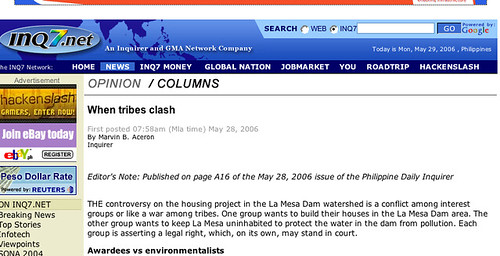
Some links to accompany the article:
1. A copy of the NIPAS law can be found here.
2. The Supreme Court decision on the land awardees can be found here.
3. The status of the ECC application on the housing project can be found here.
My wife's cousin, Agerico de Villa, who is a UP professor, reacted and said that back in 1997, the DENR has concluded that allowing residents in the area would be a security threat to Metro Manila residents. Terrorists could pose as residents and release dangerous substances to the reservoir and poison the water supply.
Some links to accompany the article:
1. A copy of the NIPAS law can be found here.
2. The Supreme Court decision on the land awardees can be found here.
3. The status of the ECC application on the housing project can be found here.
My wife's cousin, Agerico de Villa, who is a UP professor, reacted and said that back in 1997, the DENR has concluded that allowing residents in the area would be a security threat to Metro Manila residents. Terrorists could pose as residents and release dangerous substances to the reservoir and poison the water supply.
Tuesday, May 23, 2006
Can we finish a trial in one year?
The Inquirer reports that the Subic rape trial case has been scheduled for hearings three times a week every afternoon before the Regional Trial Court of Makati. Click here. The report adds that the hearings will be made daily if the trial does not progress to beat the one-year deadline under the Visiting Forces Agreement.
In my ten-year career as a lawyer, I have yet to encounter a trial completed in one year. I have seen all sorts of disappearing acts done by judges, counsels, and litigants who are the principal causes of delay in the administration of justice in this country. The classic excuse is the loose bowel movement. I've heard it so many times, that it makes me think that lawyers have the most sensitive stomachs. They are the only ones who often experience this, and they even have medical certificates to back them up.
On a different note, I once encountered a lawyer whose case was dismissed for his absence in a pre-trial hearing; his excuse -- he had an unexplained pain on his right foot. To support his claim, he sent an x-ray to the court. The trouble was he sent an x-ray of his hand instead. Yet, in spite of the obvious lie, the court relented and reinstated his case.
And so now, we have a case that has a deadline of one year, which cannot be extended even if we appealed to the President of the United States. And it would seem, even if the court burned down, the judge, lawyers, and litigants are determined to finish the case before the deadline.
Finally we are learning that speeding up our court processes is all a matter of political will.
In my ten-year career as a lawyer, I have yet to encounter a trial completed in one year. I have seen all sorts of disappearing acts done by judges, counsels, and litigants who are the principal causes of delay in the administration of justice in this country. The classic excuse is the loose bowel movement. I've heard it so many times, that it makes me think that lawyers have the most sensitive stomachs. They are the only ones who often experience this, and they even have medical certificates to back them up.
On a different note, I once encountered a lawyer whose case was dismissed for his absence in a pre-trial hearing; his excuse -- he had an unexplained pain on his right foot. To support his claim, he sent an x-ray to the court. The trouble was he sent an x-ray of his hand instead. Yet, in spite of the obvious lie, the court relented and reinstated his case.
And so now, we have a case that has a deadline of one year, which cannot be extended even if we appealed to the President of the United States. And it would seem, even if the court burned down, the judge, lawyers, and litigants are determined to finish the case before the deadline.
Finally we are learning that speeding up our court processes is all a matter of political will.
Friday, May 19, 2006
Links on the La Mesa Dam Controversy
To help us understand the brewing controversy on the housing project to be constructed on the La Mesa dam water reservoir, I have gathered some links on the subject.
The latest report is the Manila Times article that says over 100 houses will sprout on the La Mesa dam watershed. Click here.
The Inquirer's summarizes the facts and its position on the matter in this editorial.
The Supreme Court decision upholding the rights of the awardees may be found here.
Jojo Robles from the Manila Standard Today argues that this provides a situation where what is legal is not right.
Neal Cruz from the Inquirer points to the UP National Hydraulic Center report that came to the conclusion that no matter what abatement and safety procedures are adopted in the construction of the housing project, the danger of water contamination remains.
Update: Manila Times report on the completed MWSS executive houses in the La Mesa dam reservoir.
The latest report is the Manila Times article that says over 100 houses will sprout on the La Mesa dam watershed. Click here.
The Inquirer's summarizes the facts and its position on the matter in this editorial.
The Supreme Court decision upholding the rights of the awardees may be found here.
Jojo Robles from the Manila Standard Today argues that this provides a situation where what is legal is not right.
Neal Cruz from the Inquirer points to the UP National Hydraulic Center report that came to the conclusion that no matter what abatement and safety procedures are adopted in the construction of the housing project, the danger of water contamination remains.
Update: Manila Times report on the completed MWSS executive houses in the La Mesa dam reservoir.
Thursday, May 18, 2006
Finally, Wifi Access in the Office!
After an initial disappointing experience with SkyDSL a year ago, we decided to sign up with them again and go back online 24/7 yesterday. I've set up the wi-fi router today, and so far, it's been great. For a year, we had to settle with ISP Bonanza prepaid cards, after cancelling the SkyDSL account a year ago, and engaging their lawyers in a test of wills. We refused to pay their final billing of PHP 5,000, because for the single month that we were with them, we were online for less than a week. Their tech guys couldn't figure out the problem, until we decided to cancel the account. But their finance guys had the nerve to bill us for the full month. Thus, we exchanged nasty demand letters with their lawyers, copy furnished the National Telecommunications Commission, until they relented, and decided to waive the charges. So did we win? Probably not, because today, we're back with them again.
For now, I'm looking at the possibilites: streaming internet radio, playing the old tv shows widget on the Mac OS X, video conferencing with clients, and most importantly, live-blogging. Geez, with all the distractions, work has become the distraction.
For now, I'm looking at the possibilites: streaming internet radio, playing the old tv shows widget on the Mac OS X, video conferencing with clients, and most importantly, live-blogging. Geez, with all the distractions, work has become the distraction.
Wednesday, May 10, 2006
Darker Clouds over the Middle East
A few days back, I thought Iran blinked. In the wake of US warnings on its nuclear development program, Iranian President Mahmoud Ahmadinejad sent a letter to George W. Bush allegedly proposing a way out of the crisis. But instead of a way out, the letter appears to be a re-statement of the history of 20th Century according to the victims of Zionism, and some loaded questions: “Why is it that any technological and scientific achievement reached in the Middle East regions is translated into and portrayed as a threat to the Zionist regime? Is not any scientific R&D one of the basic rights of nations?
Of course, we don’t expect George W. Bush to respond to the letter, and engage the Iranian President on a debate. Right now, we know the US is preparing for the worse. In a short time, we might be looking at a US-led multi-country invasion of Iran under the pre-text of the war against weapons of mass destruction, the same blueprint for the Iraqi “shock and awe” show. The question is, how would Iran’s allies respond? Inevitably, the hawks among Iran’ s sympathizers would prevail, and soon we might be looking at World War III. The doves among us should now jump into this controversy even before the military thinkers could plot. For otherwise, we might be looking at the end of the modern world.
Of course, we don’t expect George W. Bush to respond to the letter, and engage the Iranian President on a debate. Right now, we know the US is preparing for the worse. In a short time, we might be looking at a US-led multi-country invasion of Iran under the pre-text of the war against weapons of mass destruction, the same blueprint for the Iraqi “shock and awe” show. The question is, how would Iran’s allies respond? Inevitably, the hawks among Iran’ s sympathizers would prevail, and soon we might be looking at World War III. The doves among us should now jump into this controversy even before the military thinkers could plot. For otherwise, we might be looking at the end of the modern world.
Friday, May 05, 2006
Notes on the Proc. No. 1017 Decision
My plan was to do a detailed break-down of the Supreme Court's decision on Proc. No. 1017, but my urge at the moment is to hammer away on notables. Perhaps, a detailed break-down will find its place somewhere else. Meanwhile, let me jot down the following on this decision.
1. Presidential immunity anyone?
The President was sued; it's up there in the title Randolph David vs. President Gloria Arroyo. When I learned back in February that this case was filed, I knew presidential immunity was the first line of defense. It is a basic principle of law that the President may not be sued while she is in office. But it seems the Government did not even raise the matter as an issue, and instead harped on the legal standing of the petitioners to sue. I simply do not understand why the government keeps on raising the "legal standing" issue over and over again even if it is elementary that taxpayers and citizens could sue their government for violation of the constitution. Presidential immmunity would have given the government one additional winning argument to parade to the press.
2. So what does Martial Law mean?
When Proc. No. 1017 was announced, my instinct was to check out what was the legal definition of "martial law", and found it in Fr. Bernas's textbook. According to him, martial law under the 1987 Constitution is the type "which has application when the military arm does not supercede civil authority but is called upon to aid in the execution of its civil functions." (See Joaquin Bernas, A Commentary of the Constitution of the Republic of the Philippines p. 215, 1988 edition). My conclusion was that the wording of Proc. 1017 precisely contemplates that situation where the President is calling upon the military to maintain the peace and order in the entire country. I asked, doesn't this mean civilan authority is no longer functioning? If so, then Proc. No. 1017 is martial law.
But the recent Supreme Court decision said, it is not martial law, but only the exercuse of the "calling-out" power. Said the Supreme Court,
Some of the petitioners vehemently maintain that PP 1017 is actually a declaration of Martial Law. It is no so. What defines the character of PP 1017 are its wordings. It is plain therein that what the President invoked was her calling-out power.
The declaration of Martial Law is a “warn[ing] to citizens that the military power has been called upon by the executive to assist in the maintenance of law and order, and that, while the emergency lasts, they must, upon pain of arrest and punishment, not commit any acts which will in any way render more difficult the restoration of order and the enforcement of law.”
In his “Statement before the Senate Committee on Justice” on March 13, 2006, Mr. Justice Vicente V. Mendoza,[114] an authority in constitutional law, said that of the three powers of the President as Commander-in-Chief, the power to declare Martial Law poses the most severe threat to civil liberties. It is a strong medicine which should not be resorted to lightly. It cannot be used to stifle or persecute critics of the government. It is placed in the keeping of the President for the purpose of enabling him to secure the people from harm and to restore order so that they can enjoy their individual freedoms. In fact, Section 18, Art. VII, provides:
A state of martial law does not suspend the operation of the Constitution, nor supplant the functioning of the civil courts or legislative assemblies, nor authorize the conferment of jurisdiction on military courts and agencies over civilians where civil courts are able to function, nor automatically suspend the privilege of the writ.
Justice Mendoza also stated that PP 1017 is not a declaration of Martial Law. It is no more than a call by the President to the armed forces to prevent or suppress lawless violence. As such, it cannot be used to justify acts that only under a valid declaration of Martial Law can be done. Its use for any other purpose is a perversion of its nature and scope, and any act done contrary to its command is ultra vires.
Justice Mendoza further stated that specifically, (a) arrests and seizures without judicial warrants; (b) ban on public assemblies; (c) take-over of news media and agencies and press censorship; and (d) issuance of Presidential Decrees, are powers which can be exercised by the President as Commander-in-Chief only where there is a valid declaration of Martial Law or suspension of the writ of habeas corpus.
Based on the above disquisition, it is clear that PP 1017 is not a declaration of Martial Law. It is merely an exercise of President Arroyo’s calling-out power for the armed forces to assist her in preventing or suppressing lawless violence.
Can somebody please do me a comparison and contrast essay on "martial Law" and "calling-out power"? This decision has only obscured the concept of martial law more than ever. When the Supreme Court says,
The declaration of Martial Law is a “warn[ing] to citizens that the military power has been called upon by the executive to assist in the maintenance of law and order, and that, while the emergency lasts, they must, upon pain of arrest and punishment, not commit any acts which will in any way render more difficult the restoration of order and the enforcement of law.”
couldn't that apply too in the case when she declares that she is using her "calling-out" power? They say the "calling-out" power is a mere police action. But isn't martial law a police action too? Maybe I need to go back to law school.
3. The issue is REVIEW. REVIEW. REVIEW.
I could not understand why none of the petitioners challenged the factual basis for the Proc. No. 1017, and I think that was a mistake by the lawyers. We all knew that Proc. No. 1017 was termed a "Declaration of the State of Emergency" instead of the "Declaration of Martial Law" because the President and her legal team wanted to avoid a congressional review of the factual basis for the declaration. That is why it was logical for the petitioners to go to the Supreme Court primarily to challenge the factual basis of the declaration and secondarily (or even lastly) to challenge the nomeclature of the proclamation. But if only the petitioners pressed down on the issue of the factual basis, the Supreme Court would have had the chance to review the basis. It does not matter whether we get the review from Congress or from the Supreme Court so long as the declaration is reviewed by a constitutional body. The system of checks and balances on the executive would have still worked.
But as the Supreme Court ruled, the petitioners did not even challenge the factual basis for the declaration. That's why the Supreme Court had no choice but to accept the government press release behind Proc. No. 1017 one hundred percent (100%) no ifs, no buts. Oops. Lawyers missed the point. Sec. Raul Gonzalez gets one big pogi point for him and his boss.
This means many years from now when all of these things have subsided, and we look back at how history has turned out, there can be no argument that Querol's sleeper of a film clip that the government paraded after Proc. No. 1017 was declared is not just propaganda, but a legally established fact with the Supreme Court's imprimatur. What are we going to tell our children now?
Fr. Bernas claims we won this one 95% to 5%. I beg to disagree with my teacher. No sir, we lost 95% of it instead. The argument that at least the Supreme Court ruled that there can be no takeover of media companies during a state of emergency, doesn't really prevent the government from effecting the same during a state of emergency. For so long as probable cause for rebellion could be established (which coud be done with or without a state of emergency) the ordinary police power of the President gives her the power to take over an offending media company.
1. Presidential immunity anyone?
The President was sued; it's up there in the title Randolph David vs. President Gloria Arroyo. When I learned back in February that this case was filed, I knew presidential immunity was the first line of defense. It is a basic principle of law that the President may not be sued while she is in office. But it seems the Government did not even raise the matter as an issue, and instead harped on the legal standing of the petitioners to sue. I simply do not understand why the government keeps on raising the "legal standing" issue over and over again even if it is elementary that taxpayers and citizens could sue their government for violation of the constitution. Presidential immmunity would have given the government one additional winning argument to parade to the press.
2. So what does Martial Law mean?
When Proc. No. 1017 was announced, my instinct was to check out what was the legal definition of "martial law", and found it in Fr. Bernas's textbook. According to him, martial law under the 1987 Constitution is the type "which has application when the military arm does not supercede civil authority but is called upon to aid in the execution of its civil functions." (See Joaquin Bernas, A Commentary of the Constitution of the Republic of the Philippines p. 215, 1988 edition). My conclusion was that the wording of Proc. 1017 precisely contemplates that situation where the President is calling upon the military to maintain the peace and order in the entire country. I asked, doesn't this mean civilan authority is no longer functioning? If so, then Proc. No. 1017 is martial law.
But the recent Supreme Court decision said, it is not martial law, but only the exercuse of the "calling-out" power. Said the Supreme Court,
Some of the petitioners vehemently maintain that PP 1017 is actually a declaration of Martial Law. It is no so. What defines the character of PP 1017 are its wordings. It is plain therein that what the President invoked was her calling-out power.
The declaration of Martial Law is a “warn[ing] to citizens that the military power has been called upon by the executive to assist in the maintenance of law and order, and that, while the emergency lasts, they must, upon pain of arrest and punishment, not commit any acts which will in any way render more difficult the restoration of order and the enforcement of law.”
In his “Statement before the Senate Committee on Justice” on March 13, 2006, Mr. Justice Vicente V. Mendoza,[114] an authority in constitutional law, said that of the three powers of the President as Commander-in-Chief, the power to declare Martial Law poses the most severe threat to civil liberties. It is a strong medicine which should not be resorted to lightly. It cannot be used to stifle or persecute critics of the government. It is placed in the keeping of the President for the purpose of enabling him to secure the people from harm and to restore order so that they can enjoy their individual freedoms. In fact, Section 18, Art. VII, provides:
A state of martial law does not suspend the operation of the Constitution, nor supplant the functioning of the civil courts or legislative assemblies, nor authorize the conferment of jurisdiction on military courts and agencies over civilians where civil courts are able to function, nor automatically suspend the privilege of the writ.
Justice Mendoza also stated that PP 1017 is not a declaration of Martial Law. It is no more than a call by the President to the armed forces to prevent or suppress lawless violence. As such, it cannot be used to justify acts that only under a valid declaration of Martial Law can be done. Its use for any other purpose is a perversion of its nature and scope, and any act done contrary to its command is ultra vires.
Justice Mendoza further stated that specifically, (a) arrests and seizures without judicial warrants; (b) ban on public assemblies; (c) take-over of news media and agencies and press censorship; and (d) issuance of Presidential Decrees, are powers which can be exercised by the President as Commander-in-Chief only where there is a valid declaration of Martial Law or suspension of the writ of habeas corpus.
Based on the above disquisition, it is clear that PP 1017 is not a declaration of Martial Law. It is merely an exercise of President Arroyo’s calling-out power for the armed forces to assist her in preventing or suppressing lawless violence.
Can somebody please do me a comparison and contrast essay on "martial Law" and "calling-out power"? This decision has only obscured the concept of martial law more than ever. When the Supreme Court says,
The declaration of Martial Law is a “warn[ing] to citizens that the military power has been called upon by the executive to assist in the maintenance of law and order, and that, while the emergency lasts, they must, upon pain of arrest and punishment, not commit any acts which will in any way render more difficult the restoration of order and the enforcement of law.”
couldn't that apply too in the case when she declares that she is using her "calling-out" power? They say the "calling-out" power is a mere police action. But isn't martial law a police action too? Maybe I need to go back to law school.
3. The issue is REVIEW. REVIEW. REVIEW.
I could not understand why none of the petitioners challenged the factual basis for the Proc. No. 1017, and I think that was a mistake by the lawyers. We all knew that Proc. No. 1017 was termed a "Declaration of the State of Emergency" instead of the "Declaration of Martial Law" because the President and her legal team wanted to avoid a congressional review of the factual basis for the declaration. That is why it was logical for the petitioners to go to the Supreme Court primarily to challenge the factual basis of the declaration and secondarily (or even lastly) to challenge the nomeclature of the proclamation. But if only the petitioners pressed down on the issue of the factual basis, the Supreme Court would have had the chance to review the basis. It does not matter whether we get the review from Congress or from the Supreme Court so long as the declaration is reviewed by a constitutional body. The system of checks and balances on the executive would have still worked.
But as the Supreme Court ruled, the petitioners did not even challenge the factual basis for the declaration. That's why the Supreme Court had no choice but to accept the government press release behind Proc. No. 1017 one hundred percent (100%) no ifs, no buts. Oops. Lawyers missed the point. Sec. Raul Gonzalez gets one big pogi point for him and his boss.
This means many years from now when all of these things have subsided, and we look back at how history has turned out, there can be no argument that Querol's sleeper of a film clip that the government paraded after Proc. No. 1017 was declared is not just propaganda, but a legally established fact with the Supreme Court's imprimatur. What are we going to tell our children now?
Fr. Bernas claims we won this one 95% to 5%. I beg to disagree with my teacher. No sir, we lost 95% of it instead. The argument that at least the Supreme Court ruled that there can be no takeover of media companies during a state of emergency, doesn't really prevent the government from effecting the same during a state of emergency. For so long as probable cause for rebellion could be established (which coud be done with or without a state of emergency) the ordinary police power of the President gives her the power to take over an offending media company.
Sunday, April 30, 2006
The Brewing Pre-Need Storm
The link above takes you to a headline from abs-cbnnews.com. The story is about the merging of the legal teams of all pre-need victims to run after pre-need companies and their directors who obtained legal cover through court-sanctioned "corporate rehabilitation". I have a strong feeling this is the stuff that could make a revolution. Hard-earned money made by wage-earning parents were given to pre-need comanies ran by high-rolling executives. And all the billions of pesos vanished on sour investments. Do we expect the parents to simply accept that?
Personally, I think the whole pre-need system can only work if we have something like the Bangko Sentral ng Pilipinas (BSP) regulating them, instead of mere corporate regulators in the Securities and Exchange Commission (SEC). The system of check and balances and financial expertise cannot be found in the SEC. The experience and competence is with the BSP.
Meanwhile, the courts should dismiss all those "corporate-rehabilitation" cases, so the pre-need owners could meet accusations of fraud and racketeering in the proper criminal courts. If we give less than that to these pre-need victims, we are surely headed for chaos.
Personally, I think the whole pre-need system can only work if we have something like the Bangko Sentral ng Pilipinas (BSP) regulating them, instead of mere corporate regulators in the Securities and Exchange Commission (SEC). The system of check and balances and financial expertise cannot be found in the SEC. The experience and competence is with the BSP.
Meanwhile, the courts should dismiss all those "corporate-rehabilitation" cases, so the pre-need owners could meet accusations of fraud and racketeering in the proper criminal courts. If we give less than that to these pre-need victims, we are surely headed for chaos.
Thursday, April 27, 2006
CPR is maximum tolerance? Oh yeah, like 1 + 1 = 3
CPR is maximum tolerance -- That was the official line of defense that the Government presented to the Supreme Court in the decision about the constutionality of the "Calibrated Pre-emptive Response" policy of the Government in dealing with protestors. How the Government could spin that tale to the Supreme Court is an amazing act of legal wizardry, nay voodooism.
Consider the plain and simple denotative meaning of the words, "calibrated" "pre-emptive" "response". Calibrated means calculated, planned, and pre-meditated. Pre-emptive means to prevent something by disabling the enemy beforehand, as in pre-emptive strike. A response is a reaction to something. In other words, calibrated preemptive response is a planned and preventive strike before the other side could act. In Filipino, "unahan and kalaban". In Rambo terms, it means" First Blood". If you examine the context during which the policy was announced --i.e., the "tired of chasing the bully in the schoolyard" speech -- it was an abandonment of the "maximum tolerance" policy that even the late dictator Ferdinand Marcos officially honored and passed into law under B.P. 880. Sec. Eduardo Ermita in an official declaraiton as quoted by the Supreme Court said,
On Unlawful Mass Actions
In view of intelligence reports pointing to credible plans of anti-government groups to inflame the political situation, sow disorder and incite people against the duty constituted authorities, we have instructed the PNP as well as the local government units to strictly enforce a “no permit, no rally” policy, disperse groups that run afoul of this standard and arrest all persons violating the laws of the land as well as ordinances on the proper conduct of mass actions and demonstrations.
The rule of calibrated preemptive response is now in force, in lieu of maximum tolerance. The authorities will not stand aside while those with ill intent are herding a witting or unwitting mass of people and inciting them into actions that are inimical to public order, and the peace of mind of the national community.
Unlawful mass actions will be dispersed. The majority of law-abiding citizens have the right to be protected by a vigilant and proactive government.
We appeal to the detractors of the government to engage in lawful and peaceful conduct befitting of a democratic society.
The President’s call for unity and reconciliation stands, based on the rule of law.
The key sentence is "The rule of calibrated preemptive response is now in force, in lieu of maximum tolerance." In layman's terms, "maximum tolerance" goes out the door. CPR goes in.
So how did the Government theorize that CPR is also maximum tolerance? The ponente of CPR decision, Justice Adolfo Azcuna thankfully quoted the affidavit of the same Executive Secretary Eduardo Ermita so the world and Filipinos of all ages could forever remember this myth:
The Court now comes to the matter of the CPR. As stated earlier, the Solicitor General has conceded that the use of the term should now be discontinued, since it does not mean anything other than the maximum tolerance policy set forth in B.P. No. 880. This is stated in the Affidavit of respondent Executive Secretary Eduardo Ermita, submitted by the Solicitor General, thus:
14. The truth of the matter is the policy of “calibrated preemptive response” is in consonance with the legal definition of “maximum tolerance” under Section 3 (c) of B.P. Blg. 880, which is the “highest degree of restraint that the military, police and other peacekeeping authorities shall observe during a public assembly or in the dispersal of the same.” Unfortunately, however, the phrase “maximum tolerance” has acquired a different meaning over the years. Many have taken it to mean inaction on the part of law enforcers even in the face of mayhem and serious threats to public order. More so, other felt that they need not bother secure a permit when holding rallies thinking this would be “tolerated.” Clearly, the popular connotation of “maximum tolerance” has departed from its real essence under B.P. Blg. 880.
15. It should be emphasized that the policy of maximum tolerance is provided under the same law which requires all pubic assemblies to have a permit, which allows the dispersal of rallies without a permit, and which recognizes certain instances when water cannons may be used. This could only mean that “maximum tolerance” is not in conflict with a “no permit, no rally policy” or with the dispersal and use of water cannons under certain circumstances for indeed, the maximum amount of tolerance required is dependent on how peaceful or unruly a mass action is. Our law enforcers should calibrate their response based on the circumstances on the ground with the view to preempting the outbreak of violence.
16. Thus, when I stated that calibrated preemptive response is being enforced in lieu of maximum tolerance I clearly was not referring to its legal definition but to the distorted and much abused definition that it has now acquired. I only wanted to disabuse the minds of the public from the notion that law enforcers would shirk their responsibility of keeping the peace even when confronted with dangerously threatening behavior. I wanted to send a message that we would no longer be lax in enforcing the law but would henceforth follow it to the letter. Thus I said, “we have instructed the PNP as well as the local government units to strictly enforce a no permit, no rally policy . . . arrest all persons violating the laws of the land . . . unlawful mass actions will be dispersed.” None of these is at loggerheads with the letter and spirit of Batas Pambansa Blg. 880. It is thus absurd for complainants to even claim that I ordered my co-respondents to violate any law.[25]
At any rate, the Court rules that in view of the maximum tolerance mandated by B.P. No. 880, CPR serves no valid purpose if it means the same thing as maximum tolerance and is illegal if it means something else.
Now, isn't that such a nice trick of legal voodooism? I could almost imagine Sec. Ermita scratching his head and saying, "CPR is the same as maximim tolerance" as he turns around winking. Sec. Ermita is one lucky fellow, for Justice Azcuna is one of the most polite and eloquent jurists around. If I were the ponente in this case, I would have declared Ermita in contempt of court, and sent him to jail with the added task of copying 1,000,000 times in long hand the meaning of the words "calibrated" "preemptive" "response" as defined in all the dictionaries of the Malacanang library. But that was never Justice Azcuna's style.
Consider the plain and simple denotative meaning of the words, "calibrated" "pre-emptive" "response". Calibrated means calculated, planned, and pre-meditated. Pre-emptive means to prevent something by disabling the enemy beforehand, as in pre-emptive strike. A response is a reaction to something. In other words, calibrated preemptive response is a planned and preventive strike before the other side could act. In Filipino, "unahan and kalaban". In Rambo terms, it means" First Blood". If you examine the context during which the policy was announced --i.e., the "tired of chasing the bully in the schoolyard" speech -- it was an abandonment of the "maximum tolerance" policy that even the late dictator Ferdinand Marcos officially honored and passed into law under B.P. 880. Sec. Eduardo Ermita in an official declaraiton as quoted by the Supreme Court said,
On Unlawful Mass Actions
In view of intelligence reports pointing to credible plans of anti-government groups to inflame the political situation, sow disorder and incite people against the duty constituted authorities, we have instructed the PNP as well as the local government units to strictly enforce a “no permit, no rally” policy, disperse groups that run afoul of this standard and arrest all persons violating the laws of the land as well as ordinances on the proper conduct of mass actions and demonstrations.
The rule of calibrated preemptive response is now in force, in lieu of maximum tolerance. The authorities will not stand aside while those with ill intent are herding a witting or unwitting mass of people and inciting them into actions that are inimical to public order, and the peace of mind of the national community.
Unlawful mass actions will be dispersed. The majority of law-abiding citizens have the right to be protected by a vigilant and proactive government.
We appeal to the detractors of the government to engage in lawful and peaceful conduct befitting of a democratic society.
The President’s call for unity and reconciliation stands, based on the rule of law.
The key sentence is "The rule of calibrated preemptive response is now in force, in lieu of maximum tolerance." In layman's terms, "maximum tolerance" goes out the door. CPR goes in.
So how did the Government theorize that CPR is also maximum tolerance? The ponente of CPR decision, Justice Adolfo Azcuna thankfully quoted the affidavit of the same Executive Secretary Eduardo Ermita so the world and Filipinos of all ages could forever remember this myth:
The Court now comes to the matter of the CPR. As stated earlier, the Solicitor General has conceded that the use of the term should now be discontinued, since it does not mean anything other than the maximum tolerance policy set forth in B.P. No. 880. This is stated in the Affidavit of respondent Executive Secretary Eduardo Ermita, submitted by the Solicitor General, thus:
14. The truth of the matter is the policy of “calibrated preemptive response” is in consonance with the legal definition of “maximum tolerance” under Section 3 (c) of B.P. Blg. 880, which is the “highest degree of restraint that the military, police and other peacekeeping authorities shall observe during a public assembly or in the dispersal of the same.” Unfortunately, however, the phrase “maximum tolerance” has acquired a different meaning over the years. Many have taken it to mean inaction on the part of law enforcers even in the face of mayhem and serious threats to public order. More so, other felt that they need not bother secure a permit when holding rallies thinking this would be “tolerated.” Clearly, the popular connotation of “maximum tolerance” has departed from its real essence under B.P. Blg. 880.
15. It should be emphasized that the policy of maximum tolerance is provided under the same law which requires all pubic assemblies to have a permit, which allows the dispersal of rallies without a permit, and which recognizes certain instances when water cannons may be used. This could only mean that “maximum tolerance” is not in conflict with a “no permit, no rally policy” or with the dispersal and use of water cannons under certain circumstances for indeed, the maximum amount of tolerance required is dependent on how peaceful or unruly a mass action is. Our law enforcers should calibrate their response based on the circumstances on the ground with the view to preempting the outbreak of violence.
16. Thus, when I stated that calibrated preemptive response is being enforced in lieu of maximum tolerance I clearly was not referring to its legal definition but to the distorted and much abused definition that it has now acquired. I only wanted to disabuse the minds of the public from the notion that law enforcers would shirk their responsibility of keeping the peace even when confronted with dangerously threatening behavior. I wanted to send a message that we would no longer be lax in enforcing the law but would henceforth follow it to the letter. Thus I said, “we have instructed the PNP as well as the local government units to strictly enforce a no permit, no rally policy . . . arrest all persons violating the laws of the land . . . unlawful mass actions will be dispersed.” None of these is at loggerheads with the letter and spirit of Batas Pambansa Blg. 880. It is thus absurd for complainants to even claim that I ordered my co-respondents to violate any law.[25]
At any rate, the Court rules that in view of the maximum tolerance mandated by B.P. No. 880, CPR serves no valid purpose if it means the same thing as maximum tolerance and is illegal if it means something else.
Now, isn't that such a nice trick of legal voodooism? I could almost imagine Sec. Ermita scratching his head and saying, "CPR is the same as maximim tolerance" as he turns around winking. Sec. Ermita is one lucky fellow, for Justice Azcuna is one of the most polite and eloquent jurists around. If I were the ponente in this case, I would have declared Ermita in contempt of court, and sent him to jail with the added task of copying 1,000,000 times in long hand the meaning of the words "calibrated" "preemptive" "response" as defined in all the dictionaries of the Malacanang library. But that was never Justice Azcuna's style.
Tuesday, April 25, 2006
EO 464, the Power of Inquiry, Executive Privilege, and the Many Ways of Skinning a Cat (Part 2)
This post is a few days late, and before it becomes stale (what with the new Supreme Court decision declaring the calibrated Pre-emptive Response policy of the government as unconstitutional) I will now continue with the analysis I began a post back.
In the earlier post, I stated that the invalidation of Section 2(b) and Section 3 of EO 464 appears to be inconsequential to the Government, because the decision allows some information to be covered by executive privilege, for so long as the President deems it so. The trick, therefore, is in the classification of information, which is a prerogative of the executive.
In providing support to the dispositive portion of the decision, the Supreme Court traced the history of the legislative power of inquiry under the 1987 and 1973 Constitutions and the classic case of Arnault v. Nazareno at the time when the 1935 Constitution was in place.
The Court said that,
"As discussed in Arnault, the power of inquiry, “with process to enforce it,” is grounded on the necessity of information in the legislative process. If the information possessed by executive officials on the operation of their offices is necessary for wise legislation on that subject, by parity of reasoning, Congress has the right to that information and the power to compel the disclosure thereof."
The Court further ruled that if abused, the power of inquiry is subject to judicial review. The Court then drops a bomb at the conclusion of the discussion:
"Even where the inquiry is in aid of legislation, there are still recognized exemptions to the power of inquiry, which exemptions fall under the rubric of 'executive privilege.'"
The Court proceeded to define the nature of executive privilege after acknowledging that the concept originated from the Americans. The Court said,
“Schwartz defines executive privilege as “the power of the Government to withhold information from the public, the courts, and the Congress.” Similarly, Rozell defines it as “the right of the President and high-level executive branch officers to withhold information from Congress, the courts, and ultimately the public.”
The Court then ruled that there may be three possible types of the privilege. One variety of the privilege is the state secrets privilege invoked by U.S. Presidents, beginning with Washington, on the ground that the information is of such nature that its disclosure would subvert crucial military or diplomatic objectives. Another variety is the informer’s privilege, or the privilege of the Government not to disclose the identity of persons who furnish information of violations of law to officers charged with the enforcement of that law. Finally, a generic privilege for internal deliberations has been said to attach to intragovernmental documents reflecting advisory opinions, recommendations and deliberations comprising part of a process by which governmental decisions and policies are formulated.
The Court then looked into the US vs. Nixon case and several leading Philippine decisions on executive privilege before concluding that executive privilege, whether asserted against Congress, the courts, or the public, is recognized only in relation to certain types of information of a sensitive character.
The Court said,
“While executive privilege is a constitutional concept, a claim thereof may be valid or not depending on the ground invoked to justify it and the context in which it is made. Noticeably absent is any recognition that executive officials are exempt from the duty to disclose information by the mere fact of being executive officials. Indeed, the extraordinary character of the exemptions indicates that the presumption inclines heavily against executive secrecy and in favor of disclosure. “
When I got to this part, I was grinning, because it declared that the presumption is that all information is public in character, and executive secrecy is not favored.
Then the Court proceeded to dissect Section 1 of EO 464 and distinguished between the power of inquiry under the Question Hour and the power of inquiry in aid of legislation. The Court rummaged through the records of the deliberations of the Constitutional Commission (CONCOM), and found that the CONCOM willed it so that the power of inquiry during the Question Hour may not be enforced against heads of departments without the consent of the President. The rule, however, is different with respect to the exercise of the power of inquiry in aid of legislation. The Court said, the President’s consent is not required for inquiries in aid of legislation, and only a claim of executive privilege by the President or the Executive Secretary may excuse the non-appearance of the heads of department.
The Court then proceeded with the analysis that whenever EO 464 is invoked by an executive official, there is actually an implied assertion that the official is in possession of information that is privileged in character. Then, at this point, the Court struck this implied assertion as invalid, because executive privilege, by its nature should be concretely asserted. The Court said,
"A claim of privilege, being a claim of exemption from an obligation to disclose information, must, therefore, be clearly asserted. As U.S. v. Reynolds teaches:
The privilege belongs to the government and must be asserted by it; it can neither be claimed nor waived by a private party. It is not to be lightly invoked. There must be a formal claim of privilege, lodged by the head of the department which has control over the matter, after actual personal consideration by that officer. The court itself must determine whether the circumstances are appropriate for the claim of privilege, and yet do so without forcing a disclosure of the very thing the privilege is designed to protect.
Absent then a statement of the specific basis of a claim of executive privilege, there is no way of determining whether it falls under one of the traditional privileges, or whether, given the circumstances in which it is made, it should be respected."
Then the Court swung back in favor of Executive Privilege by declaring that Congress, however, "must not require the executive to state the reasons for the claim with such particularity as to compel disclosure of the information which the privilege is meant to protect... To sustain the privilege, it need only be evident from the implications of the question, in the setting in which it is asked, that a responsive answer to the question or an explanation of why it cannot be answered might be dangerous because injurious disclosure could result.”
And this is the operative line that creative legal minds can exploit to be able to invoke executive privilege as a means to escape public accountability: injurious disclosure. Injurious to whom? The incumbent President or the State? As Dean Jorge Bocobo, puts it, the Supreme Court took away the bullets but left the gun in the hands of the President. Already I can hear the Executive Secretary claiming that continuing the Senate inquiry on the Venable Contract would result in injurious disclosure of state secrets. The same is true with the inquiry on the military participation in the cheating during the 2004 presidential elections. The Executive Secretary could claim that it would result in injurious disclosure that would weaken the morale of the military as an institution. The same spin could be made on the investigation on the fertilizer scam. Of course, the Supreme Court said that it has the power to review whether the assertion of executive privilege is proper. But the question is will the Supreme Court's exercise of the power of judicial review ever be timely?
There are many ways of skinning a cat, as the cliche goes. While for now the heads of department may not simply invoke EO 464 to evade inquiries in aid of legislation, they could still evade them by claiming 'executive privilege' and "injurious disclosure". It's all a matter of legal semantics. Instead of an appeal, I would expect the Government to revise EO 464, and integrate the catch phrase: "injurious disclosure" in the guidelines. For this reason, I do not expect any Senate inquiriy on the Venable Contract, military participation in 2004 elections, and other investigations stalled by EO 464 to reopen for now or forever.
In the earlier post, I stated that the invalidation of Section 2(b) and Section 3 of EO 464 appears to be inconsequential to the Government, because the decision allows some information to be covered by executive privilege, for so long as the President deems it so. The trick, therefore, is in the classification of information, which is a prerogative of the executive.
In providing support to the dispositive portion of the decision, the Supreme Court traced the history of the legislative power of inquiry under the 1987 and 1973 Constitutions and the classic case of Arnault v. Nazareno at the time when the 1935 Constitution was in place.
The Court said that,
"As discussed in Arnault, the power of inquiry, “with process to enforce it,” is grounded on the necessity of information in the legislative process. If the information possessed by executive officials on the operation of their offices is necessary for wise legislation on that subject, by parity of reasoning, Congress has the right to that information and the power to compel the disclosure thereof."
The Court further ruled that if abused, the power of inquiry is subject to judicial review. The Court then drops a bomb at the conclusion of the discussion:
"Even where the inquiry is in aid of legislation, there are still recognized exemptions to the power of inquiry, which exemptions fall under the rubric of 'executive privilege.'"
The Court proceeded to define the nature of executive privilege after acknowledging that the concept originated from the Americans. The Court said,
“Schwartz defines executive privilege as “the power of the Government to withhold information from the public, the courts, and the Congress.” Similarly, Rozell defines it as “the right of the President and high-level executive branch officers to withhold information from Congress, the courts, and ultimately the public.”
The Court then ruled that there may be three possible types of the privilege. One variety of the privilege is the state secrets privilege invoked by U.S. Presidents, beginning with Washington, on the ground that the information is of such nature that its disclosure would subvert crucial military or diplomatic objectives. Another variety is the informer’s privilege, or the privilege of the Government not to disclose the identity of persons who furnish information of violations of law to officers charged with the enforcement of that law. Finally, a generic privilege for internal deliberations has been said to attach to intragovernmental documents reflecting advisory opinions, recommendations and deliberations comprising part of a process by which governmental decisions and policies are formulated.
The Court then looked into the US vs. Nixon case and several leading Philippine decisions on executive privilege before concluding that executive privilege, whether asserted against Congress, the courts, or the public, is recognized only in relation to certain types of information of a sensitive character.
The Court said,
“While executive privilege is a constitutional concept, a claim thereof may be valid or not depending on the ground invoked to justify it and the context in which it is made. Noticeably absent is any recognition that executive officials are exempt from the duty to disclose information by the mere fact of being executive officials. Indeed, the extraordinary character of the exemptions indicates that the presumption inclines heavily against executive secrecy and in favor of disclosure. “
When I got to this part, I was grinning, because it declared that the presumption is that all information is public in character, and executive secrecy is not favored.
Then the Court proceeded to dissect Section 1 of EO 464 and distinguished between the power of inquiry under the Question Hour and the power of inquiry in aid of legislation. The Court rummaged through the records of the deliberations of the Constitutional Commission (CONCOM), and found that the CONCOM willed it so that the power of inquiry during the Question Hour may not be enforced against heads of departments without the consent of the President. The rule, however, is different with respect to the exercise of the power of inquiry in aid of legislation. The Court said, the President’s consent is not required for inquiries in aid of legislation, and only a claim of executive privilege by the President or the Executive Secretary may excuse the non-appearance of the heads of department.
The Court then proceeded with the analysis that whenever EO 464 is invoked by an executive official, there is actually an implied assertion that the official is in possession of information that is privileged in character. Then, at this point, the Court struck this implied assertion as invalid, because executive privilege, by its nature should be concretely asserted. The Court said,
"A claim of privilege, being a claim of exemption from an obligation to disclose information, must, therefore, be clearly asserted. As U.S. v. Reynolds teaches:
The privilege belongs to the government and must be asserted by it; it can neither be claimed nor waived by a private party. It is not to be lightly invoked. There must be a formal claim of privilege, lodged by the head of the department which has control over the matter, after actual personal consideration by that officer. The court itself must determine whether the circumstances are appropriate for the claim of privilege, and yet do so without forcing a disclosure of the very thing the privilege is designed to protect.
Absent then a statement of the specific basis of a claim of executive privilege, there is no way of determining whether it falls under one of the traditional privileges, or whether, given the circumstances in which it is made, it should be respected."
Then the Court swung back in favor of Executive Privilege by declaring that Congress, however, "must not require the executive to state the reasons for the claim with such particularity as to compel disclosure of the information which the privilege is meant to protect... To sustain the privilege, it need only be evident from the implications of the question, in the setting in which it is asked, that a responsive answer to the question or an explanation of why it cannot be answered might be dangerous because injurious disclosure could result.”
And this is the operative line that creative legal minds can exploit to be able to invoke executive privilege as a means to escape public accountability: injurious disclosure. Injurious to whom? The incumbent President or the State? As Dean Jorge Bocobo, puts it, the Supreme Court took away the bullets but left the gun in the hands of the President. Already I can hear the Executive Secretary claiming that continuing the Senate inquiry on the Venable Contract would result in injurious disclosure of state secrets. The same is true with the inquiry on the military participation in the cheating during the 2004 presidential elections. The Executive Secretary could claim that it would result in injurious disclosure that would weaken the morale of the military as an institution. The same spin could be made on the investigation on the fertilizer scam. Of course, the Supreme Court said that it has the power to review whether the assertion of executive privilege is proper. But the question is will the Supreme Court's exercise of the power of judicial review ever be timely?
There are many ways of skinning a cat, as the cliche goes. While for now the heads of department may not simply invoke EO 464 to evade inquiries in aid of legislation, they could still evade them by claiming 'executive privilege' and "injurious disclosure". It's all a matter of legal semantics. Instead of an appeal, I would expect the Government to revise EO 464, and integrate the catch phrase: "injurious disclosure" in the guidelines. For this reason, I do not expect any Senate inquiriy on the Venable Contract, military participation in 2004 elections, and other investigations stalled by EO 464 to reopen for now or forever.
Friday, April 21, 2006
EO 464, the Power of Inquiry, Executive Privilege, and the Many Ways of Skinning a Cat (Part 1)
I have been studying the recent decision of the Supreme Court (click here for a copy), and the accompanying PDI commentary (no online copy yet) of Fr. Joaquin J. Bernas, S.J., whose lectures I attended while I was a student at the Ateneo School of Law, Over the next few days, I will post my own analysis on this decision leading to a fundamental thesis, that while this decision struck down key provisions of EO 464, it also gave a way out for the President to achieve the obvious purpose in issuing EO 464, which is to control information, especially controversial ones, and avoid public accountability. So, why should people be happy about it?
The decision is a consolidation of six cases filed by senators, Bayan Muna party-list representatives, Frank Chavez, the Integrated Bar of the Philippines, Alternative Law Groups, and PDP-Laban. Penned by Justice Conchita Carpio-Morales and concurred in unanimously by thirteen other justices, including the Chief Justice, the decision was generous with citations (about 109 footnotes) from American and Philippine jurisprudence and textbooks. The fifteenth member, Justice Reynato Puno, was on leave, and did not vote. While the decision is contained in 63 long bond pages, the main issue is tackled only on 25th page, as the court has to hurdle the preliminary questions on the standing of the petitioners and the ripeness of the controversy in the more than one-third of the decision. This gives the impression that this decision is well-researched and well-written. I cannot help but note that there are no concurring opinions on the issue by the other justices, which also means that the decision is thoroughly-written. and the justices found nothing more to add to the discussion other than what Justice Carpio Morales has discussed in the opinion of the court. There is, therefore, the unlikelihhod that Solicitor General Eduardo Nachura will find any good argument to ask the Court for a reconsideration of this decision.
In tackling the constitutionality of EO 464, the Court first discussed the nature of the Power of Inquiry, Executive Privilege, and then proceeded to tackle the consitutionality of each of the provisions of EO 464. Then, it discussed the Right to Information, before summing up, and concluding with the dispositive portion that says,
"WHEREFORE, the petitions are PARTLY GRANTED. Sections 2(b) and 3 of Executive Order No. 464 (series of 2005), “Ensuring Observance of the Principle of Separation of Powers, Adherence to the Rule on Executive
Privilege and Respect for the Rights of Public Officials Appearing in Legislative Inquiries in Aid of Legislation Under the Constitution, and For Other Purposes,” are declared VOID. Sections 1 and 2(a) are, however, VALID."
To see what this dispositive portion means,after this decision has become and executory, see the quotation below:
(VALID PROVISIONS)
"SECTION 1. Appearance by Heads of Departments Before Congress. – In accordance with Article VI, Section 22 of the Constitution and to implement the Constitutional provisions on the separation of powers between co-equal branches of the government, all heads of departments of the Executive Branch of the government shall secure the consent of the President prior to appearing before either House of Congress. When the security of the State or the public interest so requires and the President so states in writing, the appearance shall only be conducted in executive session.
"SECTION. 2. Nature, Scope and Coverage of Executive Privilege. –
(a) Nature and Scope. - The rule of confidentiality based on executive privilege is fundamental to the operation of government and rooted in the separation of powers under the Constitution (Almonte vs. Vasquez, G.R. No. 95367, 23 May 1995). Further, Republic Act No. 6713 or the Code of Conduct and Ethical Standards for Public Officials and Employees provides that Public Officials and Employees shall not use or divulge confidential or classified information officially known to them by reason of their office and not made available to the public to prejudice the public interest.
Executive privilege covers all confidential or classified information between the President and the public officers covered by this executive order, including:
Conversations and correspondence between the President and the public official covered by this executive order (Almonte vs. Vasquez G.R. No. 95367, 23 May 1995; Chavez v. Public Estates Authority, G.R. No. 133250, 9 July 2002);
Military, diplomatic and other national security matters which in the interest of national security should not be divulged (Almonte vs. Vasquez, G.R. No. 95367, 23 May 1995; Chavez v. Presidential Commission on Good Government, G.R. No. 130716, 9 December 1998).
Information between inter-government agencies prior to the conclusion of treaties and executive agreements (Chavez v. Presidential Commission on Good Government, G.R. No. 130716, 9 December 1998);
Discussion in close-door Cabinet meetings (Chavez v. Presidential Commission on Good Government, G.R. No. 130716, 9 December 1998);
Matters affecting national security and public order (Chavez v. Public Estates Authority, G.R. No. 133250, 9 July 2002).
(INVALID PROVISIONS)
(b) Who are covered. – The following are covered by this executive order:
Senior officials of executive departments who in the judgment of the department heads are covered by the executive privilege;
Generals and flag officers of the Armed Forces of the Philippines and such other officers who in the judgment of the Chief of Staff are covered by the executive privilege;
Philippine National Police (PNP) officers with rank of chief superintendent or higher and such other officers who in the judgment of the Chief of the PNP are covered by the executive privilege;
Senior national security officials who in the judgment of the National Security Adviser are covered by the executive privilege; and
Such other officers as may be determined by the President.
"SECTION 3. Appearance of Other Public Officials Before Congress. – All public officials enumerated in Section 2 (b) hereof shall secure prior consent of the President prior to appearing before either House of Congress to ensure the observance of the principle of separation of powers, adherence to the rule on executive privilege and respect for the rights of public officials appearing in inquiries in aid of legislation. "
In other words, it is not accurate to say that EO 464 has been declared unconstitutional, because Sections 1 and 2(a) thereof were declared valid. It would be more accurate to say that only Sections 2(b) and 3 of EO 464 were invalidated. So, instead of filing a Motion for Reconsideration. the Solicitor General and all the President's lawyers should just find a way of working on Sections 1 and 2(a), in order to achieve the same purpose as that of the provisions that were invalidated. I am pretty sure, there are enough creative lawyers in the President's payroll to do this.
The key here is in the classification of information, which is a presidential prerogative. It is difficult, if not impossible, for any person to have the standing to question the wisdom of how the President classifies information. National security mandates that we have to take her word for it. Thus, if, for example, the President classifies the Northrail Project as confidential information, then all officials who got hold of documents and participated in this project could invoke Section 2(a). The Northrail Project then is placed beyond the reach of the public's right to information, and goes under the protective mantle of Executive Privilege, even if the project is rotten and full of corruption and kickback deals.
Who needs Section 2(b) and Section 3?
(Next post: the Power of Inquiry and Executive Privilege)
The decision is a consolidation of six cases filed by senators, Bayan Muna party-list representatives, Frank Chavez, the Integrated Bar of the Philippines, Alternative Law Groups, and PDP-Laban. Penned by Justice Conchita Carpio-Morales and concurred in unanimously by thirteen other justices, including the Chief Justice, the decision was generous with citations (about 109 footnotes) from American and Philippine jurisprudence and textbooks. The fifteenth member, Justice Reynato Puno, was on leave, and did not vote. While the decision is contained in 63 long bond pages, the main issue is tackled only on 25th page, as the court has to hurdle the preliminary questions on the standing of the petitioners and the ripeness of the controversy in the more than one-third of the decision. This gives the impression that this decision is well-researched and well-written. I cannot help but note that there are no concurring opinions on the issue by the other justices, which also means that the decision is thoroughly-written. and the justices found nothing more to add to the discussion other than what Justice Carpio Morales has discussed in the opinion of the court. There is, therefore, the unlikelihhod that Solicitor General Eduardo Nachura will find any good argument to ask the Court for a reconsideration of this decision.
In tackling the constitutionality of EO 464, the Court first discussed the nature of the Power of Inquiry, Executive Privilege, and then proceeded to tackle the consitutionality of each of the provisions of EO 464. Then, it discussed the Right to Information, before summing up, and concluding with the dispositive portion that says,
"WHEREFORE, the petitions are PARTLY GRANTED. Sections 2(b) and 3 of Executive Order No. 464 (series of 2005), “Ensuring Observance of the Principle of Separation of Powers, Adherence to the Rule on Executive
Privilege and Respect for the Rights of Public Officials Appearing in Legislative Inquiries in Aid of Legislation Under the Constitution, and For Other Purposes,” are declared VOID. Sections 1 and 2(a) are, however, VALID."
To see what this dispositive portion means,after this decision has become and executory, see the quotation below:
(VALID PROVISIONS)
"SECTION 1. Appearance by Heads of Departments Before Congress. – In accordance with Article VI, Section 22 of the Constitution and to implement the Constitutional provisions on the separation of powers between co-equal branches of the government, all heads of departments of the Executive Branch of the government shall secure the consent of the President prior to appearing before either House of Congress. When the security of the State or the public interest so requires and the President so states in writing, the appearance shall only be conducted in executive session.
"SECTION. 2. Nature, Scope and Coverage of Executive Privilege. –
(a) Nature and Scope. - The rule of confidentiality based on executive privilege is fundamental to the operation of government and rooted in the separation of powers under the Constitution (Almonte vs. Vasquez, G.R. No. 95367, 23 May 1995). Further, Republic Act No. 6713 or the Code of Conduct and Ethical Standards for Public Officials and Employees provides that Public Officials and Employees shall not use or divulge confidential or classified information officially known to them by reason of their office and not made available to the public to prejudice the public interest.
Executive privilege covers all confidential or classified information between the President and the public officers covered by this executive order, including:
Conversations and correspondence between the President and the public official covered by this executive order (Almonte vs. Vasquez G.R. No. 95367, 23 May 1995; Chavez v. Public Estates Authority, G.R. No. 133250, 9 July 2002);
Military, diplomatic and other national security matters which in the interest of national security should not be divulged (Almonte vs. Vasquez, G.R. No. 95367, 23 May 1995; Chavez v. Presidential Commission on Good Government, G.R. No. 130716, 9 December 1998).
Information between inter-government agencies prior to the conclusion of treaties and executive agreements (Chavez v. Presidential Commission on Good Government, G.R. No. 130716, 9 December 1998);
Discussion in close-door Cabinet meetings (Chavez v. Presidential Commission on Good Government, G.R. No. 130716, 9 December 1998);
Matters affecting national security and public order (Chavez v. Public Estates Authority, G.R. No. 133250, 9 July 2002).
(INVALID PROVISIONS)
(b) Who are covered. – The following are covered by this executive order:
Senior officials of executive departments who in the judgment of the department heads are covered by the executive privilege;
Generals and flag officers of the Armed Forces of the Philippines and such other officers who in the judgment of the Chief of Staff are covered by the executive privilege;
Philippine National Police (PNP) officers with rank of chief superintendent or higher and such other officers who in the judgment of the Chief of the PNP are covered by the executive privilege;
Senior national security officials who in the judgment of the National Security Adviser are covered by the executive privilege; and
Such other officers as may be determined by the President.
"SECTION 3. Appearance of Other Public Officials Before Congress. – All public officials enumerated in Section 2 (b) hereof shall secure prior consent of the President prior to appearing before either House of Congress to ensure the observance of the principle of separation of powers, adherence to the rule on executive privilege and respect for the rights of public officials appearing in inquiries in aid of legislation. "
In other words, it is not accurate to say that EO 464 has been declared unconstitutional, because Sections 1 and 2(a) thereof were declared valid. It would be more accurate to say that only Sections 2(b) and 3 of EO 464 were invalidated. So, instead of filing a Motion for Reconsideration. the Solicitor General and all the President's lawyers should just find a way of working on Sections 1 and 2(a), in order to achieve the same purpose as that of the provisions that were invalidated. I am pretty sure, there are enough creative lawyers in the President's payroll to do this.
The key here is in the classification of information, which is a presidential prerogative. It is difficult, if not impossible, for any person to have the standing to question the wisdom of how the President classifies information. National security mandates that we have to take her word for it. Thus, if, for example, the President classifies the Northrail Project as confidential information, then all officials who got hold of documents and participated in this project could invoke Section 2(a). The Northrail Project then is placed beyond the reach of the public's right to information, and goes under the protective mantle of Executive Privilege, even if the project is rotten and full of corruption and kickback deals.
Who needs Section 2(b) and Section 3?
(Next post: the Power of Inquiry and Executive Privilege)
Tuesday, April 18, 2006
To the Iblog Summit Today
The 2nd Philippine Blogging Summit shall be today, Tuesday, April 18 at the U.P. College of Law, U.P. Diliman, Quezon City from 9 am to 5 pm. Same as last year, this event is FREE!
Here’s our program for this year’s event:
9:00 to 10:00
Keynote Message
by Rebecca MacKinnon, Global Voices
Trends and Technology for Filipino Bloggers
By Emil Avancena, DotPH
Snacks
Parallel Tracks: Breakout sessions (2 Rooms)
10:30 - 12:00
Track 1: Political Blogging Panel
Panel Moderator: Atty. Fred Pamaos
Blogs and the battle for ideas: personalities and issues
by Manuel L. Quezon III
(According to MLQ3, “We have to address how people are concerned over how nasty the political debate is getting.”)
Blogging and Participatory Governance
by Davao City Councilor Peter Laviña
Track 2: Personal Blogging Panel
Panel Moderator: Noemi Lardizabal-Dado
Blogging for mere mortals
By Joel Yuvienco
Making your blog funny and humorous
by Anton De Leon
Shameless Self-Promotion: How to Be Heard in a Referral World
by Mike Abundo
12:00 LUNCH BREAK
1: 00 Keynote
Blogging and Podcasting as Tools for Political Education
By Dr. Ronald Meinardus, Friedrich Naumann Foundation
Raffle
Breakout Sessions
1:30 - 3:00
Track 3: Legal Blogging Panel
Panel Moderator: Atty. Noel Oliver Punzalan
Speak No Evil?: Libel for Bloggers
by Atty. Marvin Aceron
Look Before You Link: Avoiding Plagiarism, Copyright Infringement and Other Pitfalls
by Atty. Bong Dizon
Track 4: Art & Literary Blogging Panel
Panel Moderator: Lionel Gonzaga
Write here, Write now: The Author as a Blogger
by Dean Alfar
Comic Books and Blogging
by Jonas Diego
Blogs as Teaching Tools
By Zarah Gagatiga
BREAK
3:30 - 5:00
Track 5: Professional Blogging Panel
Panel Moderator: Atty. Ma. Elena Cardinez
Problogging: Professional Blogging and Blog Monetization
by Abe Olandres
Blogging as a Profession: From Full-Time Employee to Full Time Blogger
by J Angelo Racoma
Putting Search Engines to Work for your Blog
by Marc Hil Macalua
Tracking Blog Performance
by Charo Nuguid
Track 6: Media Blogging & Podcasting Panel
Panel Moderator: Ernesto Sonido Jr.
Blogging from a journalist’s point of view
by Ellen Tordesillas
Blogs as source for story leads
by Erwin Oliva
How to create, promote, and monetize podcasts
by Manuel Viloria
Use of Podcasting in Promoting Advocacy and Products
by Pocholo Gonzales and Brian Ligsay
CLOSING
5:00 Closing remarks, raffle, group picture taking
See you folks at iBlog2: The 2nd Philippine Blogging Summit!
Here’s our program for this year’s event:
9:00 to 10:00
Keynote Message
by Rebecca MacKinnon, Global Voices
Trends and Technology for Filipino Bloggers
By Emil Avancena, DotPH
Snacks
Parallel Tracks: Breakout sessions (2 Rooms)
10:30 - 12:00
Track 1: Political Blogging Panel
Panel Moderator: Atty. Fred Pamaos
Blogs and the battle for ideas: personalities and issues
by Manuel L. Quezon III
(According to MLQ3, “We have to address how people are concerned over how nasty the political debate is getting.”)
Blogging and Participatory Governance
by Davao City Councilor Peter Laviña
Track 2: Personal Blogging Panel
Panel Moderator: Noemi Lardizabal-Dado
Blogging for mere mortals
By Joel Yuvienco
Making your blog funny and humorous
by Anton De Leon
Shameless Self-Promotion: How to Be Heard in a Referral World
by Mike Abundo
12:00 LUNCH BREAK
1: 00 Keynote
Blogging and Podcasting as Tools for Political Education
By Dr. Ronald Meinardus, Friedrich Naumann Foundation
Raffle
Breakout Sessions
1:30 - 3:00
Track 3: Legal Blogging Panel
Panel Moderator: Atty. Noel Oliver Punzalan
Speak No Evil?: Libel for Bloggers
by Atty. Marvin Aceron
Look Before You Link: Avoiding Plagiarism, Copyright Infringement and Other Pitfalls
by Atty. Bong Dizon
Track 4: Art & Literary Blogging Panel
Panel Moderator: Lionel Gonzaga
Write here, Write now: The Author as a Blogger
by Dean Alfar
Comic Books and Blogging
by Jonas Diego
Blogs as Teaching Tools
By Zarah Gagatiga
BREAK
3:30 - 5:00
Track 5: Professional Blogging Panel
Panel Moderator: Atty. Ma. Elena Cardinez
Problogging: Professional Blogging and Blog Monetization
by Abe Olandres
Blogging as a Profession: From Full-Time Employee to Full Time Blogger
by J Angelo Racoma
Putting Search Engines to Work for your Blog
by Marc Hil Macalua
Tracking Blog Performance
by Charo Nuguid
Track 6: Media Blogging & Podcasting Panel
Panel Moderator: Ernesto Sonido Jr.
Blogging from a journalist’s point of view
by Ellen Tordesillas
Blogs as source for story leads
by Erwin Oliva
How to create, promote, and monetize podcasts
by Manuel Viloria
Use of Podcasting in Promoting Advocacy and Products
by Pocholo Gonzales and Brian Ligsay
CLOSING
5:00 Closing remarks, raffle, group picture taking
See you folks at iBlog2: The 2nd Philippine Blogging Summit!
Sunday, April 16, 2006
The Gospels Retold
I spent Black Saturday in Laiya Beach San Juan Batangas, and in between dips in the blue waters, I finished ten chapters of the book. Kazantsakis brings Christ to the monastery in the desert where he has a brief talk with the rabbi. After that conversation, Jesus begins his mission, and saves Mary Magdalene from the crowd, which was about to stone her. Then, Jesus retells the parables of the sower and the ten virgins with his disciples Simon,Jacob and Andres. Kazantsakis casts Judas as another dosciple who wants Christ to be the savior of Israel first before he becomes the savior of mankind. There is a brief exchange on this issue between the two, and I wonder how much of this material was taken from the Gospel according to Judas. The world is already celebrating Easter today, and I barely in the middle of this book. But no matter, I will continue to read it until I finish it even if it takes me until Christmas.
Happy Easter everyone!
Friday, April 14, 2006
Jesus asks forgiveness from Magdalene
I finished two chapters yesterday. Chapter 6 shows Jesus deciding to leave his mothers home to be with God in the desert monastery. In Chapter 7 Jesus stops by Magdala to beg Mary Magdalene's forgiveness. He arrives on Magdalene's house to find her long line of lovers, awaiting for their turn outside her house. One of the lovers cry, "There is no martyrdom greater than mine. Here I am in front of Paradise, and the door is closed."
Jesus talks to them, and stands in line. When his turn comes, Jesus tells Mary he is sorry. Magdalene says, "You bleat away piteously: 'It's my fault...It's my fault, my sister...I shall save you...' but oh no, you don't lift your head like a man to confess the truth. You crave my body, and insteadof saying so, which you wouldn't dare, you start blaming my soul and saying you want to save it. What soul, daydreamer? A woman's soul is her flesh. You know it, you know it; but you don't have the courage to take this soul in your arms like a man and kiss it --kiss it and save it! I pity you and detest you!"
The couple eventually settle down, and break bread together. Before retiring for the night, Magdalene tell Christ "Pleasant dreams. Tomorrow we both have much to do. You'll set out along the road again, to seek your salvation: I'll set out along another road, my own, and I too will be seeking salvation. Each his own road, and we shall never meet again. Good night." In the morning, Jesus leaves Magdalene without saying goodbye, and Magdalene weeps.
Chapter 7 is central to this book. Da Vinci Code fanatics will be frustrated to find out that Kazantsakis maintains here the vision of a celibate Christ, and Magdalene, the spurned lover who turns to prostitution instead. I am already guessing that the "Last Temptation" will bring Christ back to this scene, with Mary in despair. The story would have been simple, if Christ surrendered to Mary's yearnings, and walked away from his mission. No man would find the dilemna easy to resolve, the fulfillment of the biblical prophesy or the simple desire of family and children. Christ's pain has never been as real to me now.
Thursday, April 13, 2006
HOLY WEDNESDAY: MOTHER MARY IN DENIAL
This post is one day late, because I was caught in the frenzy of the last working day of the week yesterday. Chapter five is about Mother Mary. Kazantsakis depicts her in this chapter as a human mother who desires that her son Jesus would live a normal life. Confessing her predicament to the Rabbi, Mary says, "...I want my son like everyone else, Nothing more, nothing less. Like everyone else....Let him build troughs, cradles, plows, household utensils as his father used to do, and not, as just now, crosses to crucify human beings. Let him marry a nice young girl from a respectable home--with a dowry; let him be a liberal provider, have children, and then we'll go out together every Saturday tp the promenade--grandma, children so that everyone can admire us."
Again Kazantsakis breaks up the standard catechism about Mary. But here I think he might be right. Mary was a human being and a loving mother. Mary is honored formost for the feast of Immaculate Conception, when she uttered that "be it done to me according to Your word." But as Kazantsakis proposes perhaps after Jesus was born and have shown the possibility of living a normal life, wouldn't have Mary despaired, and prayed that Jesus be relieved from the mission? But as the Rabbi says, "Mary." he says, "if God listened to mothers we would all rot away on a bog of security and easy living."
Again Kazantsakis breaks up the standard catechism about Mary. But here I think he might be right. Mary was a human being and a loving mother. Mary is honored formost for the feast of Immaculate Conception, when she uttered that "be it done to me according to Your word." But as Kazantsakis proposes perhaps after Jesus was born and have shown the possibility of living a normal life, wouldn't have Mary despaired, and prayed that Jesus be relieved from the mission? But as the Rabbi says, "Mary." he says, "if God listened to mothers we would all rot away on a bog of security and easy living."
Tuesday, April 11, 2006
HOLY TUESDAY:JESUS THE CROSS-MAKER
This is the continuation of my reading of the Last Temptation of Christ by Nikos Kazantsakis. I had to drive early this morning to Cabanatuan City, so this post is late. I read only one chapter yesterday, although it is equivalent to two chapters if I count the number of pages.
Chapter Four is about the crucifixion of Zealot, a Christ-type character revered by the Jews but detested by the Romans. Kazantsakis puts all the characters of the eventual crucifixion of Jesus Christ in this chapter, perhaps to mirror the main crucifixion of Jesus Christ that would occur later on in the story. But in the Zealot’s crucifixion, Christ is cast as the cross-maker, and every one curses him for being a traitor to the Jews. Mother Mary is also there, and she expresses sympathy to the mother of the Zealot who died that day on the cross. Mary Magdalene appears, and she is shown to have spent the night with the Zealot on the eve of his crucifixion in order to give him the “ultimate joy”, but the Zealot has mastered his sexual appetite, and spurns her instead. The scene ends with the mother of the Zealot cursing Jesus and Mary, “My curse upon you, Son of the Carpenter. As you crucified another, may you be crucified yourself!... And you, Mary may you feel the pain that I have felt!”
Kazantsakis provides an insight into the life of Jesus with this chapter regarding Jesus Christ before he started his ministry. The Gospels do not discuss the life of Christ before he started his ministry, and all we know about him is his birth, his brief appearance at the temple as a child, his life when he began his ministry, and the circumstances of his death. Kazantsakis posits that Christ, being a son of a carpenter, is most likely a carpenter himself, and is even one who makes crosses for the violent ritual of crucifixion in those days of the Roman occupation of Israel. Many will find this revolting, but then again this is not being passed as gospel truth. If, indeed, Jesus was born to Mary who was married to Joseph, the carpenter, it is most likely that Jesus was himself a carpenter. And if he was a carpenter, he might have made crosses for those public executions.
What is the relevance of Christ being a cross-maker in his life before he started the ministry? Again, I see this from the Kazantsakis’s developmental approach. If Christ was flesh and blood, he had a life before he started his public life. Christ’s eventual shift from a “cross-maker” to a “cross-bearer” is the point of his conversion. This point of conversion is the conversion that would later save mankind. For if Christ chose to stick with his role as “cross-maker”, the entire paschal mystery of life, death, and resurrection would not have happened. But then again, there are 29 chapters to go. So I must read on.
Chapter Four is about the crucifixion of Zealot, a Christ-type character revered by the Jews but detested by the Romans. Kazantsakis puts all the characters of the eventual crucifixion of Jesus Christ in this chapter, perhaps to mirror the main crucifixion of Jesus Christ that would occur later on in the story. But in the Zealot’s crucifixion, Christ is cast as the cross-maker, and every one curses him for being a traitor to the Jews. Mother Mary is also there, and she expresses sympathy to the mother of the Zealot who died that day on the cross. Mary Magdalene appears, and she is shown to have spent the night with the Zealot on the eve of his crucifixion in order to give him the “ultimate joy”, but the Zealot has mastered his sexual appetite, and spurns her instead. The scene ends with the mother of the Zealot cursing Jesus and Mary, “My curse upon you, Son of the Carpenter. As you crucified another, may you be crucified yourself!... And you, Mary may you feel the pain that I have felt!”
Kazantsakis provides an insight into the life of Jesus with this chapter regarding Jesus Christ before he started his ministry. The Gospels do not discuss the life of Christ before he started his ministry, and all we know about him is his birth, his brief appearance at the temple as a child, his life when he began his ministry, and the circumstances of his death. Kazantsakis posits that Christ, being a son of a carpenter, is most likely a carpenter himself, and is even one who makes crosses for the violent ritual of crucifixion in those days of the Roman occupation of Israel. Many will find this revolting, but then again this is not being passed as gospel truth. If, indeed, Jesus was born to Mary who was married to Joseph, the carpenter, it is most likely that Jesus was himself a carpenter. And if he was a carpenter, he might have made crosses for those public executions.
What is the relevance of Christ being a cross-maker in his life before he started the ministry? Again, I see this from the Kazantsakis’s developmental approach. If Christ was flesh and blood, he had a life before he started his public life. Christ’s eventual shift from a “cross-maker” to a “cross-bearer” is the point of his conversion. This point of conversion is the conversion that would later save mankind. For if Christ chose to stick with his role as “cross-maker”, the entire paschal mystery of life, death, and resurrection would not have happened. But then again, there are 29 chapters to go. So I must read on.
Monday, April 10, 2006
Holy Monday: Was Christ Free to Reject His Mission?
I finished three chapters yesterday, about half of the goal for the day, but adequate to get myself warmed up with the book. Kazantsakis's prose is dazzling, kinetic, hypnotic, and reminiscent of Nick Joaquin's great fiction.
The opening chapter takes the reader to the Garden of Gethsemene while Christ was fasting and praying. Kazantsakis describes the scene according to the five senses: dark, warm, the air was stenched with the odor of sour human sweat, and the night at once silent and then another filled with a human cry. "...God of Israel! Adonai! How long...?
The next chapter flashes back to a young Christ, a crossmaker, who receives a visitor in his shop, Judas Iscariot. The chapter ends with Iscariot crying, "You--you do what you like, cross-maker! You're a coward, a good-for-othing traitor like your brother the town crier! But God will throw fire on yu just as he threw it on your father, and burn you up. That's what I say--and let it be something or you to remember me by."
Chapter three brings Christ to Cana with his mother for the purpose of choosing a wife. He finds Mary Magdalene, a daugher of his uncle the rabbi, and chooses her to be his wife. But as he anounces his choice, he is tormented by ten claws that nail themselves on his head, a psychic prcedent of things to come. He is tormented by God, says the his uncle the rabbi, who was asked to exorcise Christ by his mother, Kazantsakis portrays the young Christ as an ordinary young man who feels the ways of men, somebody who had desires, including that of marrying and having childern, but God torments him with a psychic crown of thorns.
I am a thirty-five year old Catholic, who was raised by the cathechism of pre-Vatican II Catholic grandmothers who went to mass everyday. You can imagine the resistance going on in my head as I read this book from paragraph to paragraph and chapter to chapter. Yet, I keep telling myself, this is a work of fiction, and to read it side by side with the gospels would be to miss the point entirely. It is not intended to supplant the gospels; it is a fictional portrayal of the humanity of Christ. In order to appreciate the merits of the book therefore, it should be read according to those terms.
I can imagine Kazantsakis's troubles with the creative dilemnas that arise one after another in every step of the writing process of this book. When did Christ realize he was the Messiah? How was it revealed to him? How did he take this revelation? Kazantsakis takes the developmental approach. Christ did not know he was the Messiah, but God made sure Christ knew about it directly from Him, but Christ had to agree, To make Christ agree, Christ is tormented by God with the psychic crown of thorns. I find the proposition quite ridiculous. It makes Christ a prisoner of God's plan. What choice did Christ have then? And as we all know, Christ will accept the mission, but did he accept it for the right reason? Surely, accepting the mission for the sole purpose of evading God's psychic crown of thorns is flimsy and downright preposterous. But I will withhold further judgment until more details are revealed in the book.
The opening chapter takes the reader to the Garden of Gethsemene while Christ was fasting and praying. Kazantsakis describes the scene according to the five senses: dark, warm, the air was stenched with the odor of sour human sweat, and the night at once silent and then another filled with a human cry. "...God of Israel! Adonai! How long...?
The next chapter flashes back to a young Christ, a crossmaker, who receives a visitor in his shop, Judas Iscariot. The chapter ends with Iscariot crying, "You--you do what you like, cross-maker! You're a coward, a good-for-othing traitor like your brother the town crier! But God will throw fire on yu just as he threw it on your father, and burn you up. That's what I say--and let it be something or you to remember me by."
Chapter three brings Christ to Cana with his mother for the purpose of choosing a wife. He finds Mary Magdalene, a daugher of his uncle the rabbi, and chooses her to be his wife. But as he anounces his choice, he is tormented by ten claws that nail themselves on his head, a psychic prcedent of things to come. He is tormented by God, says the his uncle the rabbi, who was asked to exorcise Christ by his mother, Kazantsakis portrays the young Christ as an ordinary young man who feels the ways of men, somebody who had desires, including that of marrying and having childern, but God torments him with a psychic crown of thorns.
I am a thirty-five year old Catholic, who was raised by the cathechism of pre-Vatican II Catholic grandmothers who went to mass everyday. You can imagine the resistance going on in my head as I read this book from paragraph to paragraph and chapter to chapter. Yet, I keep telling myself, this is a work of fiction, and to read it side by side with the gospels would be to miss the point entirely. It is not intended to supplant the gospels; it is a fictional portrayal of the humanity of Christ. In order to appreciate the merits of the book therefore, it should be read according to those terms.
I can imagine Kazantsakis's troubles with the creative dilemnas that arise one after another in every step of the writing process of this book. When did Christ realize he was the Messiah? How was it revealed to him? How did he take this revelation? Kazantsakis takes the developmental approach. Christ did not know he was the Messiah, but God made sure Christ knew about it directly from Him, but Christ had to agree, To make Christ agree, Christ is tormented by God with the psychic crown of thorns. I find the proposition quite ridiculous. It makes Christ a prisoner of God's plan. What choice did Christ have then? And as we all know, Christ will accept the mission, but did he accept it for the right reason? Surely, accepting the mission for the sole purpose of evading God's psychic crown of thorns is flimsy and downright preposterous. But I will withhold further judgment until more details are revealed in the book.
Sunday, April 09, 2006
Blog Book for Lent: The Last Temptation of Christ
The season of lent has come, and I begin a little project for my own spiritual formation (oh yes, lawyers get a conscience attack once in a while).
I have with me a paperback edition of Nikos Kazantsakis's The Last Temptation of Christ. The book was originally published in 1952 in Greece. What I will attempt to do is blog my insights, impressions, and thoughts as I read the book during this Holy Week in between my preparations for the coming Iblog Conference, (in which I will deliver a talk on libel and blogging) and a family vacation in San Juan, Batangas, my wife's hometown.
The book has 33 chapters, about 496 pages and printed in 9 points with serifs font. I will have my Treo 650 in tow so I can email to this blog for updates. To be able to finish by Easter Sunday, the plan is to read about 5 to 6 chapters a day, and to post every morning before breakfast, after my left brain has processed the reading the previous day.
Why this book? Let me take you the author's prologue, in which he writes,
"My principal anguish, and the wellspring of all my joys and sorrows, has been the incessant merciless battle between the spirit and the flesh. . . . Every man partakes of the divine nature in both his spirit and his flesh. That is why the mystery of Christ is not simply a mystery for a particular creed; it is universal. . . . Struggle between the flesh and the spirit, rebellion and resistance, reconciliation and submission, and finally-the supreme purpose of the struggle-union with God: this was the ascent taken by Christ, the ascent which he invites us to take as well, following in his bloody tracks. . . . If we are to be able to follow him, we must have a profound knowledge of His conflict, we must relive his anguish. . . . In order to mount to the Cross, the summit of sacrifice, and to God, the summit of immateriality, Christ passed through all the stages which the man who struggles passes through. All-and that is why his suffering is so familiar to us; that is why we pity him, and why his final victory seems to us so much our own future victory. That part of Christ's nature which was profoundly human helps us to understand him and love him and to pursue his Passion as though it were our own. If he had not within him this warm human element, he would never be able to touch our hearts with such assurance and tenderness; he would not be able to become a model for our lives. We struggle, we see him struggle also, and we find strength. We see that we are not all alone in the world; he is fighting at our side. . . . This book was written because I wanted to offer a supreme model to the man who struggles; I wanted to show him that he must not fear pain, temptation, or death-because all three can be conquered, all three have already been conquered."
To write, read, and blog about reading this book all have the same end in mind, a deeper and richer understanding about the mystery of Christ, which is no less than the mystery of man. But as NVM Gonzalez, used to say, every reading is an opportunity for misreading. So don't take my word for it. Get a copy of the book, and let's blog on during this Holy Week.
I have with me a paperback edition of Nikos Kazantsakis's The Last Temptation of Christ. The book was originally published in 1952 in Greece. What I will attempt to do is blog my insights, impressions, and thoughts as I read the book during this Holy Week in between my preparations for the coming Iblog Conference, (in which I will deliver a talk on libel and blogging) and a family vacation in San Juan, Batangas, my wife's hometown.
The book has 33 chapters, about 496 pages and printed in 9 points with serifs font. I will have my Treo 650 in tow so I can email to this blog for updates. To be able to finish by Easter Sunday, the plan is to read about 5 to 6 chapters a day, and to post every morning before breakfast, after my left brain has processed the reading the previous day.
Why this book? Let me take you the author's prologue, in which he writes,
"My principal anguish, and the wellspring of all my joys and sorrows, has been the incessant merciless battle between the spirit and the flesh. . . . Every man partakes of the divine nature in both his spirit and his flesh. That is why the mystery of Christ is not simply a mystery for a particular creed; it is universal. . . . Struggle between the flesh and the spirit, rebellion and resistance, reconciliation and submission, and finally-the supreme purpose of the struggle-union with God: this was the ascent taken by Christ, the ascent which he invites us to take as well, following in his bloody tracks. . . . If we are to be able to follow him, we must have a profound knowledge of His conflict, we must relive his anguish. . . . In order to mount to the Cross, the summit of sacrifice, and to God, the summit of immateriality, Christ passed through all the stages which the man who struggles passes through. All-and that is why his suffering is so familiar to us; that is why we pity him, and why his final victory seems to us so much our own future victory. That part of Christ's nature which was profoundly human helps us to understand him and love him and to pursue his Passion as though it were our own. If he had not within him this warm human element, he would never be able to touch our hearts with such assurance and tenderness; he would not be able to become a model for our lives. We struggle, we see him struggle also, and we find strength. We see that we are not all alone in the world; he is fighting at our side. . . . This book was written because I wanted to offer a supreme model to the man who struggles; I wanted to show him that he must not fear pain, temptation, or death-because all three can be conquered, all three have already been conquered."
To write, read, and blog about reading this book all have the same end in mind, a deeper and richer understanding about the mystery of Christ, which is no less than the mystery of man. But as NVM Gonzalez, used to say, every reading is an opportunity for misreading. So don't take my word for it. Get a copy of the book, and let's blog on during this Holy Week.
Wednesday, April 05, 2006
Beware of Lawyers? (part 2)
Continuing from yesterday's post, we were left with the allegation of the Complainant that the Respondent lawyer obtained USD20,000 from her in the guise that it was a deposit that was required by law for the isuance of a 13(G) visa. The lawyer, meanwhile, said the money did not go to him, but to another lawyer who was already dead. The lawyer admitteed though that he signed the receipt.
The Supreme Court refused to believe the lawyer's story. The key evidence is a set of letters written by the lawyer to the Complainant, in which letters the lawyer repeatedly assures payment to the Complainant, after apparent repeated failures to pay. There was also nothing in the letters that showed the money was obtained by another lawyer who has ddied, contrary to the respondent lawyer's alibi to the Supreme Court.
Thus, the Supreme Court ordered the disbarment of the lawyer. Said the Supreme Court,
Respondent’s act of asking money from complainant in consideration of the latter’s pending application for visas is violative of Rule 1.01[17] of the Code of Professional Responsibility, which prohibits members of the Bar from engaging or participating in any unlawful, dishonest, or deceitful acts. Moreover, said acts constitute a breach of Rule 6.02[18] of the Code which bars lawyers in government service from promoting their private interest. Promotion of private interest includes soliciting gifts or anything of monetary value in any transaction requiring the approval of his office or which may be affected by the functions of his office.[19] Respondent’s conduct in office betrays the integrity and good moral character required from all lawyers, especially from one occupying a high public office. A lawyer in public office is expected not only to refrain from any act or omission which might tend to lessen the trust and confidence of the citizenry in government; he must also uphold the dignity of the legal profession at all times and observe a high standard of honesty and fair dealing. Otherwise said, a lawyer in government service is a keeper of the public faith and is burdened with high degree of social responsibility, perhaps higher than his brethren in private practice.
In a desperate attempt to put up a smoke or to camouflage his misdeed, he went on committing another by issuing several worthless checks, thereby compounding his case.
In a recent case, we have held that the issuance of worthless checks constitutes gross misconduct, as the effect “transcends the private interests of the parties directly involved in the transaction and touches the interests of the community at large. The mischief it creates is not only a wrong to the payee or holder, but also an injury to the public since the circulation of valueless commercial papers can very well pollute the channels of trade and commerce, injure the banking system and eventually hurt the welfare of society and the public interest. Thus, paraphrasing Black’s definition, a drawer who issues an unfunded check deliberately reneges on his private duties he owes his fellow men or society in a manner contrary to accepted and customary rule of right and duty, justice, honesty or good morals.”
Consequently, we have held that the act of a person in issuing a check knowing at the time of the issuance that he or she does not have sufficient funds in, or credit with, the drawee bank for the payment of the check in full upon its presentment, is also a manifestation of moral turpitude.
Respondent’s acts are more despicable. Not only did he misappropriate the money of complainant; worse, he had the gall to prepare receipts with the letterhead of the BID and issued checks to cover up his misdeeds. Clearly, he does not deserve to continue, being a member of the bar.
Time and again, we have declared that the practice of law is a noble profession. It is a special privilege bestowed only upon those who are competent intellectually, academically and morally. A lawyer must at all times conduct himself, especially in his dealings with his clients and the public at large, with honesty and integrity in a manner beyond reproach. He must faithfully perform his duties to society, to the bar, to the courts and to his clients. A violation of the high standards of the legal profession subjects the lawyer to administrative sanctions which includes suspension and disbarment. More importantly, possession of good moral character must be continuous as a requirement to the enjoyment of the privilege of law practice; otherwise, the loss thereof is a ground for the revocation of such privilege.
Indeed, the primary objective of administrative cases against lawyers is not only to punish and discipline the erring individual lawyers but also to safeguard the administration of justice by protecting the courts and the public from the misconduct of lawyers, and to remove from the legal profession persons whose utter disregard of their lawyer’s oath have proven them unfit to continue discharging the trust reposed in them as members of the bar. These pronouncement gain practical significance in the case at bar considering that respondent was a former member of the Board of Special Inquiry of the BID. It bears stressing also that government lawyers who are public servants owe fidelity to the public service, a public trust. As such, government lawyers should be more sensitive to their professional obligations as their disreputable conduct is more likely to be magnified in the public eye.
As a lawyer, who was also a public officer, respondent miserably failed to cope with the strict demands and high standards of the legal profession.
Section 27, Rule 138 of the Revised Rules of Court mandates that a lawyer may be disbarred or suspended by this Court for any of the following acts: (1) deceit; (2) malpractice; (3) gross misconduct in office; (4) grossly immoral conduct; (5) conviction of a crime involving moral turpitude ; (6) violation of the lawyer’s oath; (7) willful disobedience of any lawful order of a superior court; and (8) willfully appearing as an attorney for a party without authority to do so.
In Atty. Vitriolo v. Atty. Dasig, we ordered the disbarment of a lawyer who, during her tenure as OIC, Legal Services, Commission on Higher Education, demanded sums of money as consideration for the approval of applications and requests awaiting action by her office. In Lim v. Barcelona, we also disbarred a senior lawyer of the National Labor Relations Commission, who was caught by the National Bureau of Investigation in the act of receiving and counting money extorted from a certain person.
Respondent’s acts constitute gross misconduct; and consistent with the need to maintain the high standards of the Bar and thus preserve the faith of the public in the legal profession, respondent deserves the ultimate penalty of expulsion from the esteemed brotherhood of lawyers.
WHEREFORE, Atty. Fred L. Gutierrez is hereby DISBARRED from the practice of law and ordered to return the amount he received from the complainant with legal interest from his receipt of the money until payment. This case shall be referred to the Office of the Ombudsman for criminal prosecution for violation of Anti-Graft and Corrupt Practices Acts and to the Department of Justice for appropriate administrative action. Let copies of this Decision be furnished the Bar Confidant to be spread on the records of the respondent; the Integrated Bar of the Philippines for distribution to all its chapters; and the Office of the Court Administrator for dissemination to all courts throughout the country.
(GISELA HUYSSEN, vs. ATTY. FRED L. GUTIERREZ, A.C. No. 6707 PER CURIAM March 24, 2006)
The Supreme Court refused to believe the lawyer's story. The key evidence is a set of letters written by the lawyer to the Complainant, in which letters the lawyer repeatedly assures payment to the Complainant, after apparent repeated failures to pay. There was also nothing in the letters that showed the money was obtained by another lawyer who has ddied, contrary to the respondent lawyer's alibi to the Supreme Court.
Thus, the Supreme Court ordered the disbarment of the lawyer. Said the Supreme Court,
Respondent’s act of asking money from complainant in consideration of the latter’s pending application for visas is violative of Rule 1.01[17] of the Code of Professional Responsibility, which prohibits members of the Bar from engaging or participating in any unlawful, dishonest, or deceitful acts. Moreover, said acts constitute a breach of Rule 6.02[18] of the Code which bars lawyers in government service from promoting their private interest. Promotion of private interest includes soliciting gifts or anything of monetary value in any transaction requiring the approval of his office or which may be affected by the functions of his office.[19] Respondent’s conduct in office betrays the integrity and good moral character required from all lawyers, especially from one occupying a high public office. A lawyer in public office is expected not only to refrain from any act or omission which might tend to lessen the trust and confidence of the citizenry in government; he must also uphold the dignity of the legal profession at all times and observe a high standard of honesty and fair dealing. Otherwise said, a lawyer in government service is a keeper of the public faith and is burdened with high degree of social responsibility, perhaps higher than his brethren in private practice.
In a desperate attempt to put up a smoke or to camouflage his misdeed, he went on committing another by issuing several worthless checks, thereby compounding his case.
In a recent case, we have held that the issuance of worthless checks constitutes gross misconduct, as the effect “transcends the private interests of the parties directly involved in the transaction and touches the interests of the community at large. The mischief it creates is not only a wrong to the payee or holder, but also an injury to the public since the circulation of valueless commercial papers can very well pollute the channels of trade and commerce, injure the banking system and eventually hurt the welfare of society and the public interest. Thus, paraphrasing Black’s definition, a drawer who issues an unfunded check deliberately reneges on his private duties he owes his fellow men or society in a manner contrary to accepted and customary rule of right and duty, justice, honesty or good morals.”
Consequently, we have held that the act of a person in issuing a check knowing at the time of the issuance that he or she does not have sufficient funds in, or credit with, the drawee bank for the payment of the check in full upon its presentment, is also a manifestation of moral turpitude.
Respondent’s acts are more despicable. Not only did he misappropriate the money of complainant; worse, he had the gall to prepare receipts with the letterhead of the BID and issued checks to cover up his misdeeds. Clearly, he does not deserve to continue, being a member of the bar.
Time and again, we have declared that the practice of law is a noble profession. It is a special privilege bestowed only upon those who are competent intellectually, academically and morally. A lawyer must at all times conduct himself, especially in his dealings with his clients and the public at large, with honesty and integrity in a manner beyond reproach. He must faithfully perform his duties to society, to the bar, to the courts and to his clients. A violation of the high standards of the legal profession subjects the lawyer to administrative sanctions which includes suspension and disbarment. More importantly, possession of good moral character must be continuous as a requirement to the enjoyment of the privilege of law practice; otherwise, the loss thereof is a ground for the revocation of such privilege.
Indeed, the primary objective of administrative cases against lawyers is not only to punish and discipline the erring individual lawyers but also to safeguard the administration of justice by protecting the courts and the public from the misconduct of lawyers, and to remove from the legal profession persons whose utter disregard of their lawyer’s oath have proven them unfit to continue discharging the trust reposed in them as members of the bar. These pronouncement gain practical significance in the case at bar considering that respondent was a former member of the Board of Special Inquiry of the BID. It bears stressing also that government lawyers who are public servants owe fidelity to the public service, a public trust. As such, government lawyers should be more sensitive to their professional obligations as their disreputable conduct is more likely to be magnified in the public eye.
As a lawyer, who was also a public officer, respondent miserably failed to cope with the strict demands and high standards of the legal profession.
Section 27, Rule 138 of the Revised Rules of Court mandates that a lawyer may be disbarred or suspended by this Court for any of the following acts: (1) deceit; (2) malpractice; (3) gross misconduct in office; (4) grossly immoral conduct; (5) conviction of a crime involving moral turpitude ; (6) violation of the lawyer’s oath; (7) willful disobedience of any lawful order of a superior court; and (8) willfully appearing as an attorney for a party without authority to do so.
In Atty. Vitriolo v. Atty. Dasig, we ordered the disbarment of a lawyer who, during her tenure as OIC, Legal Services, Commission on Higher Education, demanded sums of money as consideration for the approval of applications and requests awaiting action by her office. In Lim v. Barcelona, we also disbarred a senior lawyer of the National Labor Relations Commission, who was caught by the National Bureau of Investigation in the act of receiving and counting money extorted from a certain person.
Respondent’s acts constitute gross misconduct; and consistent with the need to maintain the high standards of the Bar and thus preserve the faith of the public in the legal profession, respondent deserves the ultimate penalty of expulsion from the esteemed brotherhood of lawyers.
WHEREFORE, Atty. Fred L. Gutierrez is hereby DISBARRED from the practice of law and ordered to return the amount he received from the complainant with legal interest from his receipt of the money until payment. This case shall be referred to the Office of the Ombudsman for criminal prosecution for violation of Anti-Graft and Corrupt Practices Acts and to the Department of Justice for appropriate administrative action. Let copies of this Decision be furnished the Bar Confidant to be spread on the records of the respondent; the Integrated Bar of the Philippines for distribution to all its chapters; and the Office of the Court Administrator for dissemination to all courts throughout the country.
(GISELA HUYSSEN, vs. ATTY. FRED L. GUTIERREZ, A.C. No. 6707 PER CURIAM March 24, 2006)
Tuesday, April 04, 2006
BEWARE OF LAWYERS?
While browsing the Supreme Court website, I chanced upon this recent decision of the Supreme Court about a lawyer from the Bureau of Immigration who received USD 20,000 from a missionary who had a Philippine Visa problem.
The Complainant said that in 1995, while the lawyer (the "Respondent") was still connected with the Bureau of Immigration and Deportation (BID), she and her three sons, who are all American citizens, applied for Philippine Visas under Section 13[g] of the Immigration Law.
Respondent told Complainant that in order that their visa applications will be favorably acted upon by the BID they needed to deposit a certain sum of money for a period of one year which could be withdrawn after one year. Believing that the deposit was indeed required by law, Complainant deposited with respondent on six different occasions from April 1995 to April 1996 the total amount of US$20,000. Respondent prepared receipts/vouchers as proofs that he received the amounts deposited by the complainant but refused to give her copies of official receipts despite her demands.
After one year, Complainant demanded from respondent the return of US$20,000 who assured her that said amount would be returned. When Respondent failed to return the sum deposited, the World Mission for Jesus (of which Complainant was a member) sent a demand letter to Respondent for the immediate return of the money. In a letter dated 1 March 1999, respondent promised to release the amount not later than 9 March 1999. Failing to comply with his promise, the World Mission for Jesus sent another demand letter. In response thereto, respondent sent Complainant a letter dated 19 March 1999 explaining the alleged reasons for the delay in the release of deposited amount. He enclosed two blank checks postdated to 6 April and 20 April 1999 and authorized complainant to fill in the amounts. When Complainant deposited the postdated checks on their due dates, the same were dishonored because Respondent had stopped payment on the same.
Thereafter, Respondent, in his letter to Complainant dated 25 April 1999, explained the reasons for stopping payment on the checks, and gave complainant five postdated checks with the assurance that said checks would be honored. Complainant deposited the five postdated checks on their due dates but they were all dishonored for having been drawn against insufficient funds or payment thereon was ordered stopped by respondent. After respondent made several unfulfilled promises to return the deposited amount, complainant referred the matter to a lawyer who sent two demand letters to respondent. The demand letters remained unheeded.
The amazing thing is the Respondent had a different spin in the story. He claims that:
He never physically received the money mentioned in the complaint, he could not have appropriated or pocketed the same. He said the amount was used as payment for services rendered for obtaining the permanent visas in the Philippines. Respondent explained thus:
"a) Through a close-friend, Jovie Galaraga, a Pastor and likewise a friend of the complainant, the latter was introduced to me at my office at the Bureau of Immigration with a big problem concerning their stay in the Philippines, herself and three sons, one of which is already of major age while the two others were still minors then. Their problem was the fact that since they have been staying in the Philippines for almost ten (10) years as holders of missionary visas (9G) they could no longer extend their said status as under the law and related polic[i]es of the government, missionary visa holders could only remain as such for ten (10) years after which they could no longer extend their said status and have to leave the country.
b) Studying their case and being U.S. Citizen (sic), I advised them that they better secure a permanent visa under Section 3 of the Philippine Immigration Law otherwise known as Quota Visa and thereafter, provided them with list of the requirements in obtaining the said visa, one of which is that the applicant must have a $40,000 deposited in the bank. I also inform that her son Marcus Huyssen, who was already of major age, has to have the same amount of show money separate of her money as he would be issued separate visa, while her two minor children would be included as her dependents in her said visa application. I advised them to get a lawyer (sic), complainant further requested me to refer to her to a lawyer to work for their application, which I did and contacted the late Atty. Mendoza, an Immigration lawyer, to do the job for the complainant and her family.
c) The application was filed, processed and followed-up by the said Atty. Mendoza until the same was finished and the corresponding permanent visa were obtained by the complainant and her family. Her son Marcus Huyssen was given an independent permanent visa while the other two were made as dependents of the complainant. In between the processing of the papers and becoming very close to the complainant, I became the intermediary between complainant and their counsel so much that every amount that the latter would request for whatever purpose was coursed through me which request were then transmitted to the complainant and every amount of money given by the complainant to their counsel were coursed thru me which is the very reason why my signature appears in the vouchers attached in the complaint-affidavit;
d) That as time goes by, I noticed that the amount appeared to be huge for services of a lawyer that I myself began to wonder why and, to satisfy my curiosity, I met Atty. Mendoza and inquired from him regarding the matter and the following facts were revealed to me:
1) That what was used by the complainant as her show money from the bank is not really her money but money of World Mission for Jesus, which therefore is a serious violation of the Immigration Law as there was a misrepresentation. This fact was confirmed later when the said entity sent their demand letter to the undersigned affiant and which is attached to the complaint-affidavit;
2) That worst, the same amount used by the complainant, was the very same amount used by her son Marcus Huyssen, in obtaining his separate permanent visa. These acts of the complainant and her son could have been a ground for deportation and likewise constitute criminal offense under the Immigration Law and the Revised Penal Code. These could have been the possible reason why complainant was made to pay for quite huge amount.
e) That after they have secured their visas, complainant and her family became very close to undersigned and my family that I was even invited to their residence several times;
f) However after three years, complainant demanded the return of their money given and surprisingly they want to recover the same from me. By twist of fate, Atty. Mendoza is no longer around, he died sometime 1997;
g) That it is unfortunate that the real facts of the matter is now being hidden and that the amount of money is now being sought to be recovered from me;
h) That the fact is I signed the vouchers and being a lawyer I know the consequences of having signed the same and therefore I had to answer for it and pay. I tried to raised the fund needed but up to the present my standby loan application has not been released and was informed that the same would only be forthcoming second week of August. The same should have been released last March but was aborted due to prevalent condition. The amount to be paid, according to the complainant has now become doubled plus attorney’s fees of P200,000.00."
Who do you think will win? Since this blog entry is getting too long, I will discuss the Supreme Court ruling tomorrow. But if you cannot wait check out this link from the Supreme Court website.
(A.C. No. 6707. March 24, 2006
Gisela Huyssen Vs. Atty. Fred L. Gutierrez)
The Complainant said that in 1995, while the lawyer (the "Respondent") was still connected with the Bureau of Immigration and Deportation (BID), she and her three sons, who are all American citizens, applied for Philippine Visas under Section 13[g] of the Immigration Law.
Respondent told Complainant that in order that their visa applications will be favorably acted upon by the BID they needed to deposit a certain sum of money for a period of one year which could be withdrawn after one year. Believing that the deposit was indeed required by law, Complainant deposited with respondent on six different occasions from April 1995 to April 1996 the total amount of US$20,000. Respondent prepared receipts/vouchers as proofs that he received the amounts deposited by the complainant but refused to give her copies of official receipts despite her demands.
After one year, Complainant demanded from respondent the return of US$20,000 who assured her that said amount would be returned. When Respondent failed to return the sum deposited, the World Mission for Jesus (of which Complainant was a member) sent a demand letter to Respondent for the immediate return of the money. In a letter dated 1 March 1999, respondent promised to release the amount not later than 9 March 1999. Failing to comply with his promise, the World Mission for Jesus sent another demand letter. In response thereto, respondent sent Complainant a letter dated 19 March 1999 explaining the alleged reasons for the delay in the release of deposited amount. He enclosed two blank checks postdated to 6 April and 20 April 1999 and authorized complainant to fill in the amounts. When Complainant deposited the postdated checks on their due dates, the same were dishonored because Respondent had stopped payment on the same.
Thereafter, Respondent, in his letter to Complainant dated 25 April 1999, explained the reasons for stopping payment on the checks, and gave complainant five postdated checks with the assurance that said checks would be honored. Complainant deposited the five postdated checks on their due dates but they were all dishonored for having been drawn against insufficient funds or payment thereon was ordered stopped by respondent. After respondent made several unfulfilled promises to return the deposited amount, complainant referred the matter to a lawyer who sent two demand letters to respondent. The demand letters remained unheeded.
The amazing thing is the Respondent had a different spin in the story. He claims that:
He never physically received the money mentioned in the complaint, he could not have appropriated or pocketed the same. He said the amount was used as payment for services rendered for obtaining the permanent visas in the Philippines. Respondent explained thus:
"a) Through a close-friend, Jovie Galaraga, a Pastor and likewise a friend of the complainant, the latter was introduced to me at my office at the Bureau of Immigration with a big problem concerning their stay in the Philippines, herself and three sons, one of which is already of major age while the two others were still minors then. Their problem was the fact that since they have been staying in the Philippines for almost ten (10) years as holders of missionary visas (9G) they could no longer extend their said status as under the law and related polic[i]es of the government, missionary visa holders could only remain as such for ten (10) years after which they could no longer extend their said status and have to leave the country.
b) Studying their case and being U.S. Citizen (sic), I advised them that they better secure a permanent visa under Section 3 of the Philippine Immigration Law otherwise known as Quota Visa and thereafter, provided them with list of the requirements in obtaining the said visa, one of which is that the applicant must have a $40,000 deposited in the bank. I also inform that her son Marcus Huyssen, who was already of major age, has to have the same amount of show money separate of her money as he would be issued separate visa, while her two minor children would be included as her dependents in her said visa application. I advised them to get a lawyer (sic), complainant further requested me to refer to her to a lawyer to work for their application, which I did and contacted the late Atty. Mendoza, an Immigration lawyer, to do the job for the complainant and her family.
c) The application was filed, processed and followed-up by the said Atty. Mendoza until the same was finished and the corresponding permanent visa were obtained by the complainant and her family. Her son Marcus Huyssen was given an independent permanent visa while the other two were made as dependents of the complainant. In between the processing of the papers and becoming very close to the complainant, I became the intermediary between complainant and their counsel so much that every amount that the latter would request for whatever purpose was coursed through me which request were then transmitted to the complainant and every amount of money given by the complainant to their counsel were coursed thru me which is the very reason why my signature appears in the vouchers attached in the complaint-affidavit;
d) That as time goes by, I noticed that the amount appeared to be huge for services of a lawyer that I myself began to wonder why and, to satisfy my curiosity, I met Atty. Mendoza and inquired from him regarding the matter and the following facts were revealed to me:
1) That what was used by the complainant as her show money from the bank is not really her money but money of World Mission for Jesus, which therefore is a serious violation of the Immigration Law as there was a misrepresentation. This fact was confirmed later when the said entity sent their demand letter to the undersigned affiant and which is attached to the complaint-affidavit;
2) That worst, the same amount used by the complainant, was the very same amount used by her son Marcus Huyssen, in obtaining his separate permanent visa. These acts of the complainant and her son could have been a ground for deportation and likewise constitute criminal offense under the Immigration Law and the Revised Penal Code. These could have been the possible reason why complainant was made to pay for quite huge amount.
e) That after they have secured their visas, complainant and her family became very close to undersigned and my family that I was even invited to their residence several times;
f) However after three years, complainant demanded the return of their money given and surprisingly they want to recover the same from me. By twist of fate, Atty. Mendoza is no longer around, he died sometime 1997;
g) That it is unfortunate that the real facts of the matter is now being hidden and that the amount of money is now being sought to be recovered from me;
h) That the fact is I signed the vouchers and being a lawyer I know the consequences of having signed the same and therefore I had to answer for it and pay. I tried to raised the fund needed but up to the present my standby loan application has not been released and was informed that the same would only be forthcoming second week of August. The same should have been released last March but was aborted due to prevalent condition. The amount to be paid, according to the complainant has now become doubled plus attorney’s fees of P200,000.00."
Who do you think will win? Since this blog entry is getting too long, I will discuss the Supreme Court ruling tomorrow. But if you cannot wait check out this link from the Supreme Court website.
(A.C. No. 6707. March 24, 2006
Gisela Huyssen Vs. Atty. Fred L. Gutierrez)
Monday, March 27, 2006
SC MONITOR: SC defines fair and true report in PJI case
SC Monitor is a new section of La Vida Lawyer where we will feature noted recent Supreme Court decisions published in the Supreme Court website, www.supremecourt.gov.ph .
PHILIPPINE JOURNALISTS, INC. (PEOPLE’S JOURNAL), ZACARIAS NUGUID, JR. and CRISTINA LEE, - versus - FRANCIS THOENEN,
G.R. No. 143372 December 13, 2005 (ABRIDGED. A complete copy of the decision is found here.
J. MINITA V. CHICO-NAZARIO wrote the opinion of the Court.
FACTS:
On 30 September 1990, the following news item appeared in the People’s Journal, a tabloid of general circulation:
"Swiss Shoots Neighbors’ Pets
RESIDENTS of a subdivision in Parañaque have asked the Bureau of Immigration to deport a Swiss who allegedly shoots wayward neighbors’ pets that he finds in his domain.
The BF Homes residents through lawyer Atty. Efren Angara complained that the deportation of Francis Thoenen, of 10 Calcutta BF Homes Phase III, could help “prevent the recurrence of such incident in the future.”
Angara explained that house owners could not control their dogs and cats when they slip out of their dwellings unnoticed.
An alleged confrontation between Thoenen and the owner of a pet he shot recently threatens to exacerbate the problem, Angara said.
Cristina Lee"
The subject of this article, Francis Thoenen, is a retired engineer permanently residing in this country with his Filipina wife and their children. Claiming that the report was false and defamatory, and that the petitioners acted irresponsibly in failing to verify the truth of the same prior to publication, he filed a civil case for damages against herein petitioners Philippine Journalists, Inc., Zacarias Nuguid, Jr., its publisher, and reporter Cristina Lee.
The principal source of the article was a letter by a certain Atty. Efren Angara addressed to Commissioner Andrea Domingo of the Commission on Immigration and Deportation (CID, now Bureau of Immigration), which states:
Dear Madame:
We would like to request your office to verify the true status/authenticity of the residency in the Philippines of a foreign national (a Swiss) by the name of Francis Thoenen who is presently residing at No. 10 Calcuta cor. Beirut Street, BF Homes (PH. III), Parañaque, Metro Manila. I received (sic) complaint from my clients residing around his vicinity that this foreigner had (sic) been causing troubles ever since he showed up. He is too meticulous and had (sic) been shooting dogs and cats passing his house wall everytime.
Such act which (sic) is unacceptable to the owners especially if inspite (sic) of control their pets slips (sic) out unnoticed. A confrontation between him and the owner of the dog he shoot, (sic) already occurred last time. In some instances this guy had been always driving his car barbarously inside the subdivision with children playing around (sic) the street. Before my clients petitioned themselves with the endorsement of the Homeowners Association and filed to your office for deportation we’re respectfully seeking your assistance to investigate this alien to prevent further incident occurrence (sic) in the future. He should not be allowed to dominate the citizens of this country.
Very truly yours,
Atty. Efren B. Angara
The petitioners claim that Lee, as the reporter assigned to cover news events in the CID, acquired a copy of the above letter from a trusted source in the CID’s Intelligence Division. They claimed to “have reasonable grounds to believe in the truth and veracity of the information derived (from their) sources.”
It was proven at trial that the news article contained several inaccuracies. The headline, which categorically stated that the subject of the article engaged in the practice of shooting pets, was untrue.[5] Moreover, it is immediately apparent from a comparison between the above letter and the news item in question that while the letter is a mere request for verification of Thoenen’s status, Lee wrote that residents of BF Homes had “asked the Bureau of Immigration to deport a Swiss who allegedly shoots neighbors’ pets.” No complaints had in fact been lodged against him by any of the BF Homeowners,[6] nor had any pending deportation proceedings been initiated against him in the Bureau of Immigration.
Thoenen also submitted a Certification from the Office of the Bar Confidant that there was no lawyer in its rolls by the name of Efren Angara, earlier cited by petitioner Lee as the author of the letter on which she based her article. Finally, the trial also showed that despite the fact that respondent’s address was indicated in the letter, Cristina Lee made no efforts to contact either him or the purported letter-writer, Atty. Angara.
HELD:
For the reasons stated below, we hold that the constitutional privilege granted under the freedom of speech and the press against liability for damages does not extend to the petitioners in this case.
“The right of free speech is not absolute at all times and under all circumstances. There are certain well-defined and narrowly limited classes of speech, the prevention and punishment of which has never been thought to raise any Constitutional problem. These include the lewd and obscene, the profane, the libelous, and the insulting or ‘fighting’ words - those which by their very utterance inflict injury or tend to incite an immediate breach of the peace. It has been well observed that such utterances are no essential part of any exposition of ideas, and are of such slight social value as a step to truth that any benefit that may be derived from them is clearly outweighed by the social interest in order and morality.” [19]
Libel is not protected speech. An allegation is considered defamatory if it ascribes to a person the commission of a crime, the possession of a vice or defect, real or imaginary, or any act, omission, condition, status or circumstance which tends to dishonor or discredit or put him in contempt, or which tends to blacken the memory of one who is dead.
As a general rule, malice is presumed. Article 354 of the Revised Penal Code states:
ART. 354. Requirement of Publicity. - Every defamatory imputation is presumed to be malicious, even if it be true, if no good intention and justifiable motive for making it is shown, except in the following cases:
1. A private communication made by any person to another in the performance of any legal, moral or social duty; and
2. A fair and true report, made in good faith, without any comments or remarks, of any judicial, legislative or other official proceedings which are not of confidential nature, or of any statement, report or speech delivered in said proceedings, or of any other act performed by public officers in the exercise of their functions.
The article is not a privileged communication. We first discussed the freedom of speech and press and assembly vis-a-vis the laws on libel and slander in the groundbreaking case of US v. Bustos, where we applied the prevailing English and American jurisprudence to the effect that:
"The interest of society and the maintenance of good government demand a full discussion of public affairs. Complete liberty to comment on the conduct of public men is a scalpel in the case of free speech. The sharp incision of its probe relieves the abscesses of officialdom. Men in public life may suffer under a hostile and an unjust accusation; the wound can be assuaged with the balm of a clear conscience. A public officer must not be too thin-skinned with reference to comment upon his official acts. Only thus can the intelligence and dignity of the individual be exalted. Of course, criticism does not authorize defamation. Nevertheless, as the individual is less than the State, so must expected criticism be born for the common good? Rising superior to any official, or set of officials, to the Chief Executive, to the Legislature, to the Judiciary - to any or all the agencies of Government - public opinion should be the constant source of liberty and democracy. (citations omitted)
The demand to protect public opinion for the welfare of society and the orderly administration of government inevitably lead to the adoption of the doctrine of privileged communication. “A privileged communication may be either absolutely privileged or qualifiedly privileged. Absolutely privileged communications are those which are not actionable even if the author has acted in bad faith. An example is found in Sec. 11, Art. VI of the 1987 Constitution which exempts a member of Congress from liability for any speech or debate in the Congress or in any Committee thereof. Upon the other hand, qualifiedly privileged communications containing defamatory imputations are not actionable unless found to have been made without good intention or justifiable motive. To this genre belong ‘private communications’ and ‘fair and true report without any comments or remarks.’”
The appellate court correctly ruled that the petitioners’ story is not privileged in character, for it is neither “private communication” nor a fair and true report without any comments or remarks.
US v. Bustos defined the concept of private communication thus: “A communication made bona fide upon any subject-matter in which the party communicating has an interest, or in reference to which he has a duty, is privileged, if made to a person having a corresponding interest or duty, although it contained criminatory matter which without this privilege would be slanderous and actionable. A pertinent illustration of the application of qualified privilege is a complaint made in good faith and without malice in regard to the character or conduct of a public official when addressed to an officer or a board having some interest or duty in the matter.”
This defense is unavailing to petitioners. In Daez v. Court of Appeals[26] we held that:
As a rule, it is the right and duty of a citizen to make a complaint of any misconduct on the part of public officials, which comes to his notice, to those charged with supervision over them. Such a communication is qualifiedly privileged and the author is not guilty of libel. The rule on privilege, however, imposes an additional requirement. Such complaints should be addressed solely to some official having jurisdiction to inquire into the charges, or power to redress the grievance or has some duty to perform or interest in connection therewith. (emphasis supplied)
In the instant case, even if we assume that the letter written by the spurious Atty. Angara is privileged communication, it lost its character as such when the matter was published in the newspaper and circulated among the general population. A written letter containing libelous matter cannot be classified as privileged when it is published and circulated in public,[27] which was what the petitioners did in this case.
Neither is the news item a fair and true report without any comments or remarks of any judicial, legislative or other official proceedings; there is in fact no proceeding to speak of. Nor is the article related to any act performed by public officers in the exercise of their functions, for it concerns only false imputations against Thoenen, a private individual seeking a quiet life.
The petitioners also claim to have made the report out of a “social and moral duty to inform the public on matters of general interest.”
In Borjal v. Court of Appeals, we stated that “the enumeration under Art. 354 is not an exclusive list of qualifiedly privileged communications since fair commentaries on matters of public interest are likewise privileged. We stated that the doctrine of fair commentaries means “that while in general every discreditable imputation publicly made is deemed false, because every man is presumed innocent until his guilt is judicially proved, and every false imputation is deemed malicious, nevertheless, when the discreditable imputation is directed against a public person in his public capacity, it is not necessarily actionable. In order that such discreditable imputation to a public official may be actionable, it must either be a false allegation of fact or a comment based on a false supposition.”
Again, this argument is unavailing to the petitioners. As we said, the respondent is a private individual, and not a public official or public figure. We are persuaded by the reasoning of the United States Supreme Court in Gertz v. Robert Welch, Inc.,[29] that a newspaper or broadcaster publishing defamatory falsehoods about an individual who is neither a public official nor a public figure may not claim a constitutional privilege against liability, for injury inflicted, even if the falsehood arose in a discussion of public interest.[30]
Having established that the article cannot be considered as privileged communication, malice is therefore presumed, and the fourth requisite for the imputation of libel to attach to the petitioners in this case is met. The news article is therefore defamatory and is not within the realm of protected speech. There is no longer a need to discuss the other assignment of errors, save for the amount of damages to which respondent is entitled.
In Policarpio v. Manila Times Publishing Co., Inc., we awarded damages where the defendants deliberately presented a private individual in a worse light that what she actually was, and where other factual errors were not prevented although defendants had the means to ascertain the veracity of their report. Such are the facts obtaining here.
We must point out that Lee’s brief news item contained falsehoods on two levels. On its face, her statement that residents of BF Homes had “asked the Bureau of Immigration to deport a Swiss who allegedly shoots neighbors’ pets” is patently untrue since the letter of the spurious Atty. Angara was a mere request for verification of Thoenen’s status as a foreign resident. Lee’s article, moreover, is also untrue, in that the events she reported never happened. The respondent had never shot any of his neighbors’ pets, no complaints had been lodged against him by his neighbors, and no deportation proceedings had been initiated against him. Worse, the author of Lee’s main source of information, Atty. Efren Angara, apparently either does not exist, or is not a lawyer. Petitioner Lee would have been enlightened on substantially all these matters had she but tried to contact either Angara or Thoenen.
Although it has been stressed that a newspaper “should not be held to account to a point of suppression for honest mistakes, or imperfection in the choice of words,” even the most liberal view of free speech has never countenanced the publication of falsehoods, especially the persistent and unmitigated dissemination of patent lies.[ “There is no constitutional value in false statements of fact. Neither the intentional lie nor the careless error materially advances society’s interest in ‘uninhibited, robust, and wide-open’ debate.” The use of the known lie as a tool is at once at odds with the premises of democratic government and with the orderly manner in which economic, social, or political change is to be effected. Calculated falsehood falls into that class of utterances which “are no essential part of any exposition of ideas, and are of such slight social value as a step to truth that any benefit that may be derived from them is clearly outweighed by the social interest in order and morality… The knowingly false statement and the false statement made with reckless disregard of the truth, do not enjoy constitutional protection” (citations omitted).
The legitimate state interest underlying the law of libel is the compensation of the individuals for the harm inflicted upon them by defamatory falsehood. After all, the individual’s right to protection of his own good name “reflects no more than our basic concept of the essential dignity and worth of every human being – a concept at the root of any decent system of ordered liberty.”[36]
The appellate court awarded Thoenen moral damages of P200,000.00, exemplary damages of P50,000.00 and legal fees of P30,000.00, to be borne jointly and severally by the herein petitioners. In Guevarra v. Almario, we noted that the damages in a libel case must depend upon the facts of the particular case and the sound discretion of the court, although appellate courts were “more likely to reduce damages for libel than to increase them.” So it is in this case.
WHEREFORE, the Decision of the Court of Appeals of 17 January 2000 reversing the Decision of the Regional Trial Court, Branch 62, Makati City, of 31 August 1994 is hereby AFFIRMED, subject to the modification that petitioners are ordered to pay, jointly and severally, moral damages in the sum of P100,000.00, exemplary damages of P30,000.00, and legal fees of P20,000.00. No costs.
SO ORDERED.
PHILIPPINE JOURNALISTS, INC. (PEOPLE’S JOURNAL), ZACARIAS NUGUID, JR. and CRISTINA LEE, - versus - FRANCIS THOENEN,
G.R. No. 143372 December 13, 2005 (ABRIDGED. A complete copy of the decision is found here.
J. MINITA V. CHICO-NAZARIO wrote the opinion of the Court.
FACTS:
On 30 September 1990, the following news item appeared in the People’s Journal, a tabloid of general circulation:
"Swiss Shoots Neighbors’ Pets
RESIDENTS of a subdivision in Parañaque have asked the Bureau of Immigration to deport a Swiss who allegedly shoots wayward neighbors’ pets that he finds in his domain.
The BF Homes residents through lawyer Atty. Efren Angara complained that the deportation of Francis Thoenen, of 10 Calcutta BF Homes Phase III, could help “prevent the recurrence of such incident in the future.”
Angara explained that house owners could not control their dogs and cats when they slip out of their dwellings unnoticed.
An alleged confrontation between Thoenen and the owner of a pet he shot recently threatens to exacerbate the problem, Angara said.
Cristina Lee"
The subject of this article, Francis Thoenen, is a retired engineer permanently residing in this country with his Filipina wife and their children. Claiming that the report was false and defamatory, and that the petitioners acted irresponsibly in failing to verify the truth of the same prior to publication, he filed a civil case for damages against herein petitioners Philippine Journalists, Inc., Zacarias Nuguid, Jr., its publisher, and reporter Cristina Lee.
The principal source of the article was a letter by a certain Atty. Efren Angara addressed to Commissioner Andrea Domingo of the Commission on Immigration and Deportation (CID, now Bureau of Immigration), which states:
Dear Madame:
We would like to request your office to verify the true status/authenticity of the residency in the Philippines of a foreign national (a Swiss) by the name of Francis Thoenen who is presently residing at No. 10 Calcuta cor. Beirut Street, BF Homes (PH. III), Parañaque, Metro Manila. I received (sic) complaint from my clients residing around his vicinity that this foreigner had (sic) been causing troubles ever since he showed up. He is too meticulous and had (sic) been shooting dogs and cats passing his house wall everytime.
Such act which (sic) is unacceptable to the owners especially if inspite (sic) of control their pets slips (sic) out unnoticed. A confrontation between him and the owner of the dog he shoot, (sic) already occurred last time. In some instances this guy had been always driving his car barbarously inside the subdivision with children playing around (sic) the street. Before my clients petitioned themselves with the endorsement of the Homeowners Association and filed to your office for deportation we’re respectfully seeking your assistance to investigate this alien to prevent further incident occurrence (sic) in the future. He should not be allowed to dominate the citizens of this country.
Very truly yours,
Atty. Efren B. Angara
The petitioners claim that Lee, as the reporter assigned to cover news events in the CID, acquired a copy of the above letter from a trusted source in the CID’s Intelligence Division. They claimed to “have reasonable grounds to believe in the truth and veracity of the information derived (from their) sources.”
It was proven at trial that the news article contained several inaccuracies. The headline, which categorically stated that the subject of the article engaged in the practice of shooting pets, was untrue.[5] Moreover, it is immediately apparent from a comparison between the above letter and the news item in question that while the letter is a mere request for verification of Thoenen’s status, Lee wrote that residents of BF Homes had “asked the Bureau of Immigration to deport a Swiss who allegedly shoots neighbors’ pets.” No complaints had in fact been lodged against him by any of the BF Homeowners,[6] nor had any pending deportation proceedings been initiated against him in the Bureau of Immigration.
Thoenen also submitted a Certification from the Office of the Bar Confidant that there was no lawyer in its rolls by the name of Efren Angara, earlier cited by petitioner Lee as the author of the letter on which she based her article. Finally, the trial also showed that despite the fact that respondent’s address was indicated in the letter, Cristina Lee made no efforts to contact either him or the purported letter-writer, Atty. Angara.
HELD:
For the reasons stated below, we hold that the constitutional privilege granted under the freedom of speech and the press against liability for damages does not extend to the petitioners in this case.
“The right of free speech is not absolute at all times and under all circumstances. There are certain well-defined and narrowly limited classes of speech, the prevention and punishment of which has never been thought to raise any Constitutional problem. These include the lewd and obscene, the profane, the libelous, and the insulting or ‘fighting’ words - those which by their very utterance inflict injury or tend to incite an immediate breach of the peace. It has been well observed that such utterances are no essential part of any exposition of ideas, and are of such slight social value as a step to truth that any benefit that may be derived from them is clearly outweighed by the social interest in order and morality.” [19]
Libel is not protected speech. An allegation is considered defamatory if it ascribes to a person the commission of a crime, the possession of a vice or defect, real or imaginary, or any act, omission, condition, status or circumstance which tends to dishonor or discredit or put him in contempt, or which tends to blacken the memory of one who is dead.
As a general rule, malice is presumed. Article 354 of the Revised Penal Code states:
ART. 354. Requirement of Publicity. - Every defamatory imputation is presumed to be malicious, even if it be true, if no good intention and justifiable motive for making it is shown, except in the following cases:
1. A private communication made by any person to another in the performance of any legal, moral or social duty; and
2. A fair and true report, made in good faith, without any comments or remarks, of any judicial, legislative or other official proceedings which are not of confidential nature, or of any statement, report or speech delivered in said proceedings, or of any other act performed by public officers in the exercise of their functions.
The article is not a privileged communication. We first discussed the freedom of speech and press and assembly vis-a-vis the laws on libel and slander in the groundbreaking case of US v. Bustos, where we applied the prevailing English and American jurisprudence to the effect that:
"The interest of society and the maintenance of good government demand a full discussion of public affairs. Complete liberty to comment on the conduct of public men is a scalpel in the case of free speech. The sharp incision of its probe relieves the abscesses of officialdom. Men in public life may suffer under a hostile and an unjust accusation; the wound can be assuaged with the balm of a clear conscience. A public officer must not be too thin-skinned with reference to comment upon his official acts. Only thus can the intelligence and dignity of the individual be exalted. Of course, criticism does not authorize defamation. Nevertheless, as the individual is less than the State, so must expected criticism be born for the common good? Rising superior to any official, or set of officials, to the Chief Executive, to the Legislature, to the Judiciary - to any or all the agencies of Government - public opinion should be the constant source of liberty and democracy. (citations omitted)
The demand to protect public opinion for the welfare of society and the orderly administration of government inevitably lead to the adoption of the doctrine of privileged communication. “A privileged communication may be either absolutely privileged or qualifiedly privileged. Absolutely privileged communications are those which are not actionable even if the author has acted in bad faith. An example is found in Sec. 11, Art. VI of the 1987 Constitution which exempts a member of Congress from liability for any speech or debate in the Congress or in any Committee thereof. Upon the other hand, qualifiedly privileged communications containing defamatory imputations are not actionable unless found to have been made without good intention or justifiable motive. To this genre belong ‘private communications’ and ‘fair and true report without any comments or remarks.’”
The appellate court correctly ruled that the petitioners’ story is not privileged in character, for it is neither “private communication” nor a fair and true report without any comments or remarks.
US v. Bustos defined the concept of private communication thus: “A communication made bona fide upon any subject-matter in which the party communicating has an interest, or in reference to which he has a duty, is privileged, if made to a person having a corresponding interest or duty, although it contained criminatory matter which without this privilege would be slanderous and actionable. A pertinent illustration of the application of qualified privilege is a complaint made in good faith and without malice in regard to the character or conduct of a public official when addressed to an officer or a board having some interest or duty in the matter.”
This defense is unavailing to petitioners. In Daez v. Court of Appeals[26] we held that:
As a rule, it is the right and duty of a citizen to make a complaint of any misconduct on the part of public officials, which comes to his notice, to those charged with supervision over them. Such a communication is qualifiedly privileged and the author is not guilty of libel. The rule on privilege, however, imposes an additional requirement. Such complaints should be addressed solely to some official having jurisdiction to inquire into the charges, or power to redress the grievance or has some duty to perform or interest in connection therewith. (emphasis supplied)
In the instant case, even if we assume that the letter written by the spurious Atty. Angara is privileged communication, it lost its character as such when the matter was published in the newspaper and circulated among the general population. A written letter containing libelous matter cannot be classified as privileged when it is published and circulated in public,[27] which was what the petitioners did in this case.
Neither is the news item a fair and true report without any comments or remarks of any judicial, legislative or other official proceedings; there is in fact no proceeding to speak of. Nor is the article related to any act performed by public officers in the exercise of their functions, for it concerns only false imputations against Thoenen, a private individual seeking a quiet life.
The petitioners also claim to have made the report out of a “social and moral duty to inform the public on matters of general interest.”
In Borjal v. Court of Appeals, we stated that “the enumeration under Art. 354 is not an exclusive list of qualifiedly privileged communications since fair commentaries on matters of public interest are likewise privileged. We stated that the doctrine of fair commentaries means “that while in general every discreditable imputation publicly made is deemed false, because every man is presumed innocent until his guilt is judicially proved, and every false imputation is deemed malicious, nevertheless, when the discreditable imputation is directed against a public person in his public capacity, it is not necessarily actionable. In order that such discreditable imputation to a public official may be actionable, it must either be a false allegation of fact or a comment based on a false supposition.”
Again, this argument is unavailing to the petitioners. As we said, the respondent is a private individual, and not a public official or public figure. We are persuaded by the reasoning of the United States Supreme Court in Gertz v. Robert Welch, Inc.,[29] that a newspaper or broadcaster publishing defamatory falsehoods about an individual who is neither a public official nor a public figure may not claim a constitutional privilege against liability, for injury inflicted, even if the falsehood arose in a discussion of public interest.[30]
Having established that the article cannot be considered as privileged communication, malice is therefore presumed, and the fourth requisite for the imputation of libel to attach to the petitioners in this case is met. The news article is therefore defamatory and is not within the realm of protected speech. There is no longer a need to discuss the other assignment of errors, save for the amount of damages to which respondent is entitled.
In Policarpio v. Manila Times Publishing Co., Inc., we awarded damages where the defendants deliberately presented a private individual in a worse light that what she actually was, and where other factual errors were not prevented although defendants had the means to ascertain the veracity of their report. Such are the facts obtaining here.
We must point out that Lee’s brief news item contained falsehoods on two levels. On its face, her statement that residents of BF Homes had “asked the Bureau of Immigration to deport a Swiss who allegedly shoots neighbors’ pets” is patently untrue since the letter of the spurious Atty. Angara was a mere request for verification of Thoenen’s status as a foreign resident. Lee’s article, moreover, is also untrue, in that the events she reported never happened. The respondent had never shot any of his neighbors’ pets, no complaints had been lodged against him by his neighbors, and no deportation proceedings had been initiated against him. Worse, the author of Lee’s main source of information, Atty. Efren Angara, apparently either does not exist, or is not a lawyer. Petitioner Lee would have been enlightened on substantially all these matters had she but tried to contact either Angara or Thoenen.
Although it has been stressed that a newspaper “should not be held to account to a point of suppression for honest mistakes, or imperfection in the choice of words,” even the most liberal view of free speech has never countenanced the publication of falsehoods, especially the persistent and unmitigated dissemination of patent lies.[ “There is no constitutional value in false statements of fact. Neither the intentional lie nor the careless error materially advances society’s interest in ‘uninhibited, robust, and wide-open’ debate.” The use of the known lie as a tool is at once at odds with the premises of democratic government and with the orderly manner in which economic, social, or political change is to be effected. Calculated falsehood falls into that class of utterances which “are no essential part of any exposition of ideas, and are of such slight social value as a step to truth that any benefit that may be derived from them is clearly outweighed by the social interest in order and morality… The knowingly false statement and the false statement made with reckless disregard of the truth, do not enjoy constitutional protection” (citations omitted).
The legitimate state interest underlying the law of libel is the compensation of the individuals for the harm inflicted upon them by defamatory falsehood. After all, the individual’s right to protection of his own good name “reflects no more than our basic concept of the essential dignity and worth of every human being – a concept at the root of any decent system of ordered liberty.”[36]
The appellate court awarded Thoenen moral damages of P200,000.00, exemplary damages of P50,000.00 and legal fees of P30,000.00, to be borne jointly and severally by the herein petitioners. In Guevarra v. Almario, we noted that the damages in a libel case must depend upon the facts of the particular case and the sound discretion of the court, although appellate courts were “more likely to reduce damages for libel than to increase them.” So it is in this case.
WHEREFORE, the Decision of the Court of Appeals of 17 January 2000 reversing the Decision of the Regional Trial Court, Branch 62, Makati City, of 31 August 1994 is hereby AFFIRMED, subject to the modification that petitioners are ordered to pay, jointly and severally, moral damages in the sum of P100,000.00, exemplary damages of P30,000.00, and legal fees of P20,000.00. No costs.
SO ORDERED.
Wednesday, March 15, 2006
DOJ charges are ridiculous -PCIJ
PCIJ Statement
IN an interview with ANC this afternoon, Justice Secretary Raul Gonzalez said that that the government is monitoring the Philippine Center for Investigative Journalism (PCIJ). “It is very clear,” he said, “they have been posting in their website many things I consider as inciting to sedition. We are studying them.”
“For example,” he added, “ the fact that it kept on posting the matters in the Garci tape is violative of [Republic Act] 4200 (the anti-wiretapping law).”
This charge is ridiculous. In June 2005, the PCIJ posted the three-hour audio recording of the alleged phone conversations of former elections commissioner Virgilio Garcillano. Our intent was to inform the public of the contents of those conversations so that they can make an independent judgment on the allegations of election fraud. The recording was clearly a matter of public interest, and it was this interest that we were upholding.
How can we be accused of inciting to sedition and of violating the anti-wiretapping law by posting the audio files of a tape that has been played in Congress? Radio and television stations have played portions of the tape as well. Press Secretary Ignacio Bunye even played and presented to the media a different version of the supposedly wiretapped recording. Moreover, that recording is posted in about a dozen other websites and blogs.
Yet the Justice Secretary has prejudged our case and made a conclusion without giving the PCIJ the benefit of due process. How can a Justice Secretary do that?
As far as we know, the Bill of Rights and the Rules of Court are still in place. We are presumed innocent until proven guilty. We cannot be pronounced guilty on his mere say so.
I would like to ask the Justice Secretary: When the PCIJ published its exposés on the unexplained wealth and mansions of former President Joseph Estrada in 2001, were we also inciting to sedition? Our reports were used in the impeachment charge against Estrada. Were we inciting to sedition then? If some people went to Edsa after reading our reports, was that inciting to sedition?
If it is, then any legitimate piece of investigative journalism is seditious. Then anything that comes out in the media today can be construed to be seditious.
Secretary Gonzalez intends to intimidate the PCIJ. That is not his job. The job of the justice system is to provide an enabling environment that allows free and responsible journalism to be practiced. It is to protect journalists like ourselves from harassment suits and ridiculous charges. Instead he has become the purveyor of these charges. We are so very disappointed.
Sheila S. Coronel
15 March 2006
IN an interview with ANC this afternoon, Justice Secretary Raul Gonzalez said that that the government is monitoring the Philippine Center for Investigative Journalism (PCIJ). “It is very clear,” he said, “they have been posting in their website many things I consider as inciting to sedition. We are studying them.”
“For example,” he added, “ the fact that it kept on posting the matters in the Garci tape is violative of [Republic Act] 4200 (the anti-wiretapping law).”
This charge is ridiculous. In June 2005, the PCIJ posted the three-hour audio recording of the alleged phone conversations of former elections commissioner Virgilio Garcillano. Our intent was to inform the public of the contents of those conversations so that they can make an independent judgment on the allegations of election fraud. The recording was clearly a matter of public interest, and it was this interest that we were upholding.
How can we be accused of inciting to sedition and of violating the anti-wiretapping law by posting the audio files of a tape that has been played in Congress? Radio and television stations have played portions of the tape as well. Press Secretary Ignacio Bunye even played and presented to the media a different version of the supposedly wiretapped recording. Moreover, that recording is posted in about a dozen other websites and blogs.
Yet the Justice Secretary has prejudged our case and made a conclusion without giving the PCIJ the benefit of due process. How can a Justice Secretary do that?
As far as we know, the Bill of Rights and the Rules of Court are still in place. We are presumed innocent until proven guilty. We cannot be pronounced guilty on his mere say so.
I would like to ask the Justice Secretary: When the PCIJ published its exposés on the unexplained wealth and mansions of former President Joseph Estrada in 2001, were we also inciting to sedition? Our reports were used in the impeachment charge against Estrada. Were we inciting to sedition then? If some people went to Edsa after reading our reports, was that inciting to sedition?
If it is, then any legitimate piece of investigative journalism is seditious. Then anything that comes out in the media today can be construed to be seditious.
Secretary Gonzalez intends to intimidate the PCIJ. That is not his job. The job of the justice system is to provide an enabling environment that allows free and responsible journalism to be practiced. It is to protect journalists like ourselves from harassment suits and ridiculous charges. Instead he has become the purveyor of these charges. We are so very disappointed.
Sheila S. Coronel
15 March 2006
Tuesday, March 14, 2006
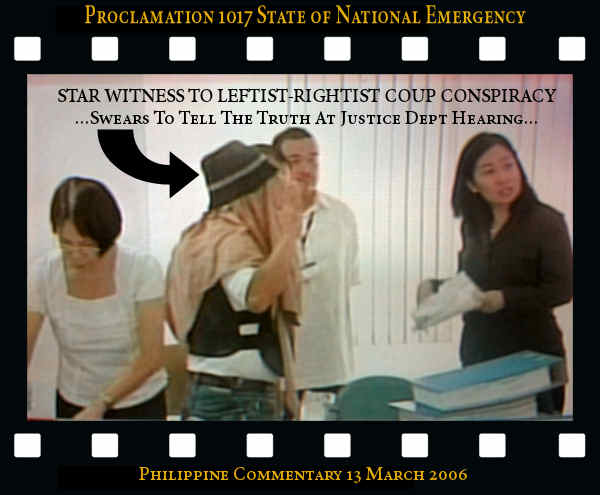
Sol-Gen Alfredo Benipayo resigns
Inq7.net reports that Solicitor General Alfredo Benipayo has tendered his resignation effective April 1, 2006, thus ending his long and distinguished career in government. Sec. Raul Gonzalez, of the Department of Justice said the reason for the resignation was Benipayo's desire to go back to private life. See story here.
Predictably, the Palace will downplay this major setback, in spite of the fact that it has a number "must-win" cases that are pending with the Supreme Court, which cases Sol-Gen Benipayo would leave behind.
But we cannot help but speculate about the reason for the sudden decision of Sol-Gen Benipayo to resign. Was he privately castigated for having admitted to the press that the police erroneously implemented Proc. No. 1017? Does he think his task of winning those "must-win" cases is impossible? Is he sick and tired of always defending the wrong side? is one plus one equals two? Was he asked to leave so a more trusted Palace protege (i.e., Sigma Rhoan, Rotarian, or Ateneo law classmate of you know who) could take his place? Yet, no matter how hard the Palace will try to unmate Benipayo's resignation with the ugliness of the cases it has thrown to the Sol-Gen's door, considering that this is a precarious situation for the Government to have its chief counsel walking out, people will think that this is a case of a lawyer dumping his impossible client.
Viva Benipayo!
Predictably, the Palace will downplay this major setback, in spite of the fact that it has a number "must-win" cases that are pending with the Supreme Court, which cases Sol-Gen Benipayo would leave behind.
But we cannot help but speculate about the reason for the sudden decision of Sol-Gen Benipayo to resign. Was he privately castigated for having admitted to the press that the police erroneously implemented Proc. No. 1017? Does he think his task of winning those "must-win" cases is impossible? Is he sick and tired of always defending the wrong side? is one plus one equals two? Was he asked to leave so a more trusted Palace protege (i.e., Sigma Rhoan, Rotarian, or Ateneo law classmate of you know who) could take his place? Yet, no matter how hard the Palace will try to unmate Benipayo's resignation with the ugliness of the cases it has thrown to the Sol-Gen's door, considering that this is a precarious situation for the Government to have its chief counsel walking out, people will think that this is a case of a lawyer dumping his impossible client.
Viva Benipayo!
Subscribe to:
Posts (Atom)